मंथिकाManthika
Menu

The bad test after the great one

A girl of about eleven in a school classroom holds up a marked test paper with a gold star on it. She wears a forest-green cap and her hair is in a high bun. Other children at desks around her are turning to look. No writing is legible anywhere in the picture.
THE GREAT TEST · Nineteen out of twenty. Tara had never seen that mark on her own paper.

Tara got 19 out of 20 in the maths test.

She had never got 19 before. Most weeks she gets 13 or 14. The paper went up on the wall at home, next to the fridge.

“Now we know what you can do,” said her mother. “From now on, this is your mark.”

Tara thought so too.
the run of results before the next test: five inside the usual range, one far above it
Tara’s last six maths tests, out of 20
test 1
test 2
test 3
test 4
test 5
test 6
TARA’S USUAL this student’s usual range is 12 to 15 out of twenty
Six tests in a row. Five sit inside the shaded band, where Tara’s marks usually land. The 19 does not.
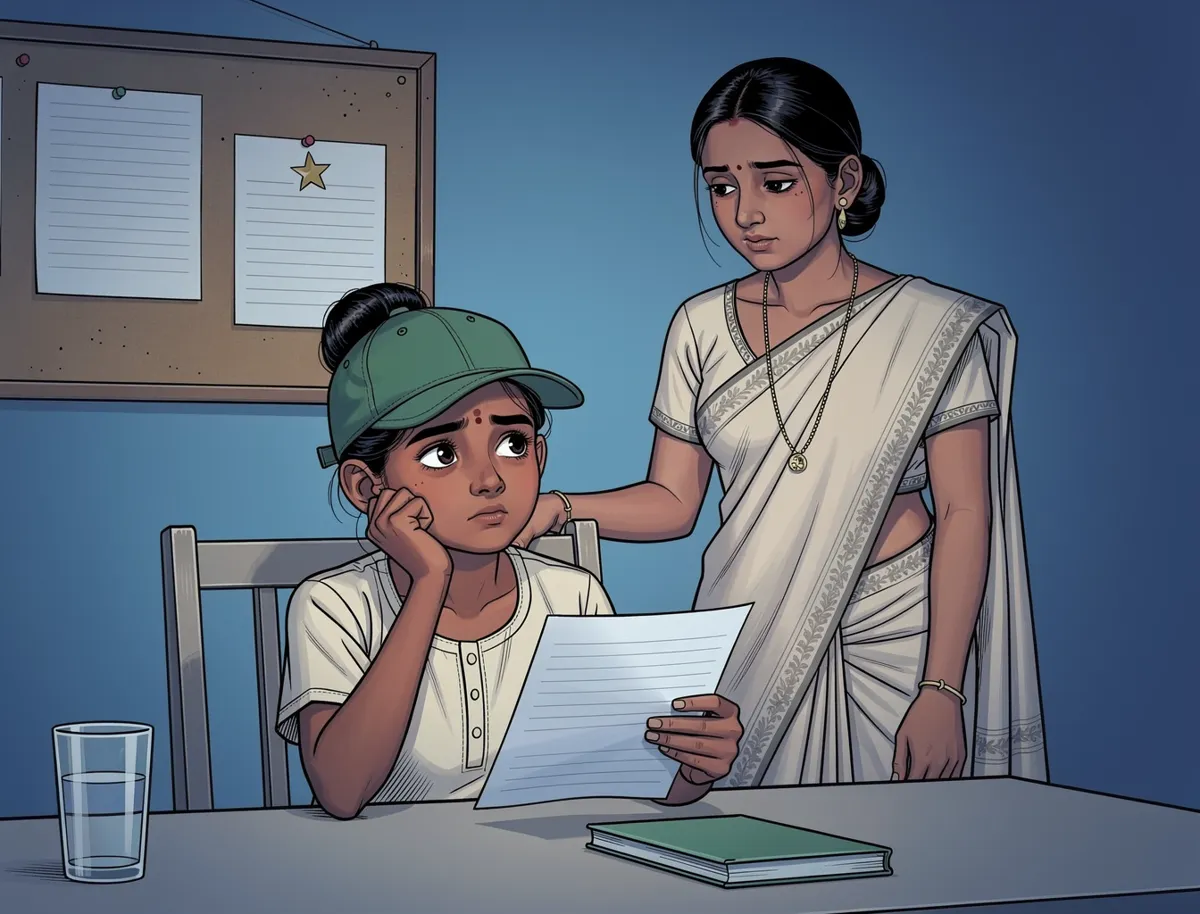
The same girl sits at a desk two weeks later with a fresh test paper in front of her and no star on it. The earlier starred paper is still pinned on the board behind her. Her expression is puzzled rather than upset.
THE NEXT TEST → · Two weeks later. The star paper is still on the board behind her.

On the next test Tara got 14. No star. “What happened?” her mother asked. “You got 19 last time. You have become careless.” Her uncle said that one good mark had gone to her head.

Tara had studied the same way as before. It felt as if she had gone backwards. Now look at where the 14 sits.

one run of results: five inside the usual range, one far above it, then one back inside
one student’s test results, out of twenty
the usual range is 12 to 15; test 6 sits far above it; test 7 is back inside it.
test 1
test 2
test 3
test 4
test 5
test 6
test 7
USUAL this student’s usual range is 12 to 15 out of twenty — read off the run, not off any one result
The same picture, with the next test added. Six of the seven sit inside the band. The 19 does not; the 14 does.

The 14 is not backwards. The 14 is Tara’s usual mark. The strange test was the 19.

↑ Back to top

The idea

Look at the shape of the whole run. Most of the marks sit close together. One sits far away. The next one comes back near the others.

That shape is not about Tara. It turns up wherever results are counted.

A LONGER LOOK

The idea

Extreme results are part luck; the next drifts back.

An extreme result is one that lands far from your usual. Very high, or very low.

Your usual is the band your marks keep landing in. Tara’s band is 12 to 15. The 19 sits outside it.

A bright everyday street scene in an Indian town on a morning when everything is going right: an empty road, a bus arriving, sunshine, a child walking easily to school. Nothing in the picture is labelled.
PART LUCK · A day when everything goes your way. You cannot arrange another one like it.

On the day of the 19, many small things went Tara’s way. The questions were the ones she had practised. She had slept well. Nobody near her was talking.

That is luck, and luck is part of every extreme result. You cannot arrange another day like that.

So the next result drifts back. Just back towards usual.

It works from the other side too. After your worst test ever, the next one is usually better, whatever you do in between.

two runs of three results: one far above usual, one far below, each followed by a result back near usual
After a very high one
After a very low one
usual
far from usual
next
USUAL this student’s usual range is 12 to 15 out of twenty
The same drift from both ends. After a mark far above usual, the next is lower; after one far below, the next is higher.

People who study chance have a name for this: regression to the mean. “Mean” is their word for your usual. “Regression” means going back.

Going back to usual.

↑ Back to top

What people believe instead

A father and a boy of about eleven sit at a table in an Indian home in the evening. The father is talking seriously and the boy is listening with his head down. A test paper lies on the table between them. Nothing written on it is legible.
THE SCOLDING · Bittu’s worst mark ever. His father spoke to him for an hour.

Bittu sits two rows behind Tara. His usual mark is 10 or 11. One week he got 4, his worst ever. His father scolded him. On the next test Bittu got 11. “See?” said his father. “Scolding works.” It had worked the last time too.

two runs: a result far below usual and a result far above it, each followed by a result back inside the usual range
Bittu
Tara
two before
one before
far from usual
next
USUAL Bittu’s usual range is 9 to 12 out of twenty
USUAL Tara’s usual range is 12 to 15 out of twenty
Bittu’s run beside Tara’s. The scolding and the praise both happened between the far-from-usual mark and the next one.

If the scolding pushed Bittu up, did the praise push Tara down? Both drifted back to usual, whatever anyone did in between. The scolding and the praise happened in the middle, so one got the credit and the other the blame.

A dim bedroom at night in an Indian home. A boy lies under a blanket with a damp cloth on his forehead and an older woman sits beside the bed holding a steel tumbler. A single lamp lights the room. No words appear anywhere in the picture.
THE WORST NIGHT · The worst night of the fever. This is the night the home drink is given.

The same shape turns up with a fever too. Bittu’s fever climbed for three nights. On the worst night his grandmother gave him a home drink. “The drink worked,” she said the next morning. She had given him the same drink before, and it always seemed to help.

Perhaps. But the worst night was the reading furthest from usual, and the next one drifts back. The drink was given in the middle, so it got the credit.

a fever at its worst point, a remedy given, and the next reading
one child’s temperature, in degrees Fahrenheit
the range marked usual is where this child’s temperature sits when well. The remedy was given on night three, the point furthest from usual.
night one
night two
night three, the worst
next morning
USUAL when this child is well the reading sits at about 98 to 99 degrees Fahrenheit
Three nights of fever and the morning after. The drink was given at the highest reading.
A LITTLE HISTORY

Read this part twice

This is only about home cures that nobody has ever properly tested. Medicines you can buy at a chemist have been tested on many people first, and that is how we know they work. Nothing in this chapter is a reason to skip one, or to stop one early.

↑ Back to top

The same idea, on a cricket ground

A schoolgirl cricketer on a dusty Indian ground raises her bat and helmet to the boundary after reaching a hundred. Teammates behind her are clapping. The scoreboard in the distance is blurred and unreadable.
104 → · Meenal’s first century for the school.

Meenal opens the batting for the school. Most days she makes twenty or thirty runs. One Saturday she made 104, her first century.

In her next three innings she made 22, 31 and 17.

“She has lost her form,” said Kavya, who bowls for the team. “The century made her proud,” said Kavya’s father.

You already know what to look for.

the same shape, on a cricket ground
runs made in an innings
the usual range is about 17 to 35 runs; the century sits far above it; the three innings after it are back inside it.
innings 1
innings 2
innings 3
the century
innings 4
innings 5
innings 6
USUAL this batter’s usual innings brings about 17 to 35 runs
Seven innings. Six of them sit inside Meenal’s band; one towers over it.

The 22, the 31 and the 17 are Meenal’s usual cricket. The strange innings was the 104. It was a great day and she earned it. It was also part luck, and you cannot arrange luck for next Saturday.

↑ Back to top

And on your own desk

A close view of a school desk with a blue ballpoint pen lying on an exercise book beside a girl’s hand. Warm afternoon light. Nothing on the page is legible.
THE LUCKY PEN? · Tara wrote the 19 with this pen.

Tara wrote the 19 with a new blue pen. For a week she called it her lucky pen.

But Tara does not believe a thing until she has checked it. She keeps a small card for this.

A STORY

Tara’s card

What I think will happen With this pen I will get high marks.

Why I think that I got 19 with it.

What would prove me wrong Three more tests with it, and I get my usual marks.

A SCHOLAR INDIA REMEMBERS

Long ago in Rajasthan, a man named Brahmagupta watched the sky and wrote down what he saw. Tara’s family still tells his stories. When the sky surprised him, he did not explain it at once. He waited, and looked again the next month. Tara looked again.

four tests with the same pen
one student’s test results, out of twenty
the usual range is 12 to 15; only the first of the four results sits outside it.
the test the pen was new for
the next test
the next
the next
USUAL this student’s usual range is 12 to 15 out of twenty
Four tests written with the same pen. Only the first sits outside the band.

She crossed “lucky pen” off the card, and did not rub it out. The crossed-out guesses are how she remembers what changed her mind.

↑ Back to top

Spot it

Two new situations. Which one idea explains both?

PUZZLE CORNER

1

A school team has its best season ever. Next year a new coach comes, and the team has an ordinary season. Everyone blames the coach.

PUZZLE CORNER

2

Your friend gets her lowest mark ever in handwriting. She changes to a new seat. Her next mark is better. She says the seat did it.

the shape itself, with no story: a run inside the usual range, one result far outside it, the next back inside
The shape to remember
far from usual
drifts back
USUAL the usual range here runs from 4.5 to 6.5
The shape to remember: a run near usual, one result far from it, and the next drifting back.

Something happened in the middle. Before you give it the credit or the blame, ask one question: was the first result far from usual?

A girl of about eleven sits on the floor beside an older relative in an Indian home, listening while they talk. Evening light. Nobody in the picture is holding a book or a paper, and no words appear anywhere.
THIS WEEK, AT HOME → · Ask, and then listen. You are collecting a story, not correcting anyone.
HANDS ON

This week, at home

Ask someone older about their best day ever at work, in a match or in an exam. Then ask what the next one was like.

One shape, three costumes. A test result, an innings, a fever. In each, a result far from usual, then something in the middle, then a next result nearer usual. And each time somebody called the thing in the middle the cause.

Extreme results are part luck; the next drifts back. So ask first whether the earlier result was far from usual.

A LITTLE HISTORY

Where you will see this next

In Part 3 this idea comes back, and you find out why the drift happens. Next chapter: a rule that stays fair whoever is on which side.

↑ Back to top