Who chooses first

Meera’s cousins Golu and Bunny had one cake, at their grandparents’ house this time. Golu picked up the knife, and Bunny was already unhappy about it.
Meera remembered the classroom cake. Last time, the fix was easy: give the knife to somebody who eats none.
She looked around the room. Everyone there wanted a slice. There was no spare cousin, no spare aunt, nobody at all to hand the knife to. This cake needed a different fix.
She thought back to last week’s classroom fix. It had worked only because somebody outside the argument was free to hold the knife. Nobody here was free at all.
The trick this time was not who held the knife. It was who chose first.
The idea
Look at what changed. Golu still cuts. But Bunny, not Golu, now picks the first slice. That one swap is the whole rule.
People who study fair division say what it buys in three words.
The idea
Mechanisms make envy impossible.
Envy is wanting the share somebody else got instead of your own. If Bunny still wished she had Golu’s piece after choosing first, the cake would still not be settled. A good rule leaves nobody wishing they had swapped, once the choosing is done. Nobody has to feel generous for that to happen. The rule does the work.
That is what mechanisms are for: not asking anyone to be generous, only asking the order to be right.
The rule

Here is the rule, with the names taken off. Whoever divides does not choose first. One person cuts. The other picks a share first. The one who cut keeps whatever is left.
Golu does not know, while he is cutting, which half will end up his. So his safest cut is the most even one he can manage. He is not being good. He is being careful. Those turn out to look the same, from outside.
Try it from Golu’s side. Cut it uneven, and Bunny takes the big half; the small one is his. Cut it even, and he keeps half whatever she picks. The rule made the careful cut the safe one.
What people believe instead
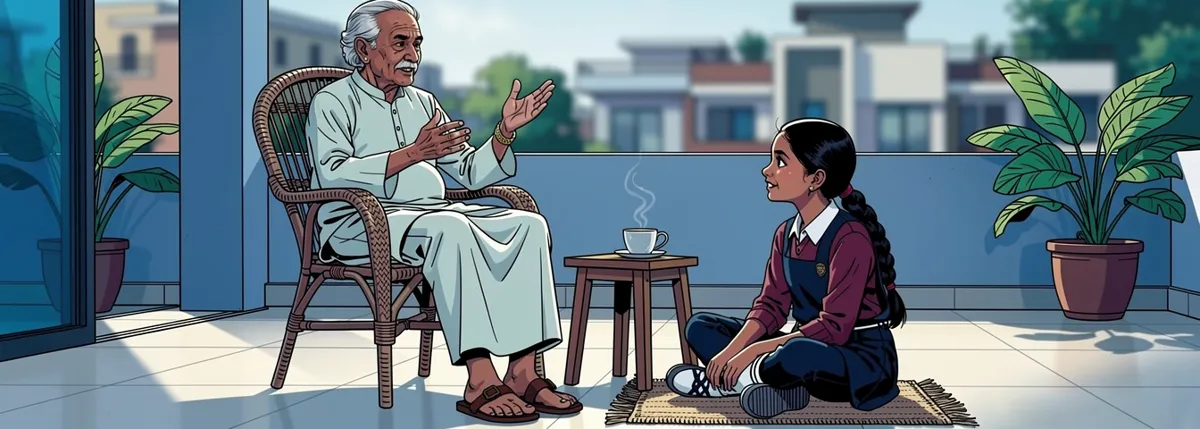
Meera told Nanaji about the cake. “Why not just pick someone fair to divide it,” he said. “Golu is a sensible boy. Trust him to be fair, and there is nothing more to arrange.”
Golu really was fair, most days.
Meera did not argue. She thought about it instead. Even a fair, sensible Golu cutting for himself gives Bunny no way to check the halves are equal. Somebody would always wonder, however good Golu’s intentions were.
Cut-and-choose does not ask Bunny to trust Golu at all. An uneven cut simply costs Golu his own slice, whatever kind of boy he is.
The same idea, twice more
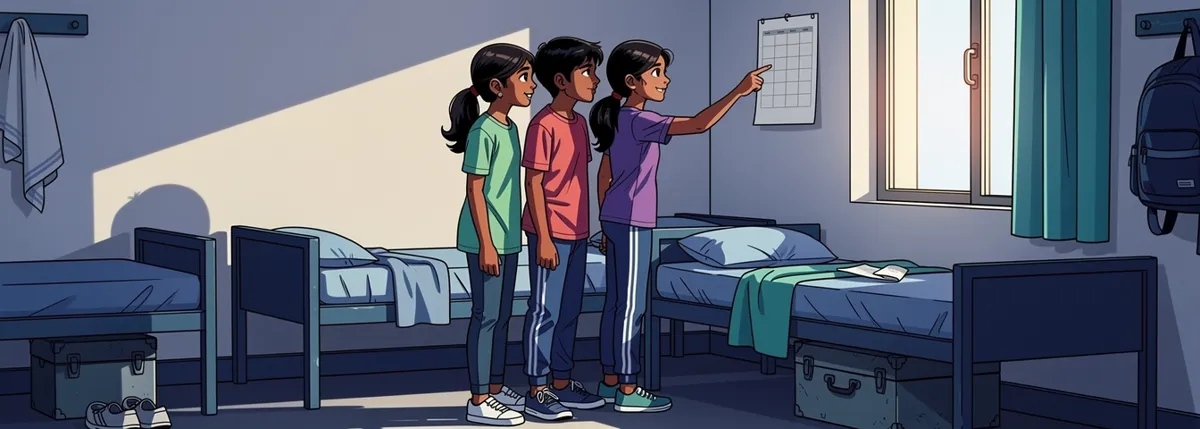
Meera’s cousin Ritu didi shares a hostel room with two others. All three wanted the bed by the window, and all three had a reason.
Nobody argued about who deserved it most. Nobody was declared the fairest judge of the three. They agreed on a rotation instead: one month each, written on the calendar on the wall.
Nobody has to trust anyone’s sense of fairness. The turn just moves, on its own, whoever is in the room that month.
A rotation is a cut too. The year is the cake, and the calendar cuts it into equal turns. Nobody holds the knife, so nobody can cut a bigger slice for herself.

Farhan, Aditi and Priya finished their project late, and ordered one pizza to share. Farhan had the knife this time.
Nobody handed the slices to a fourth person this time — there were only the three of them. Farhan simply cut, and ate last, after Aditi and Priya had both chosen a slice.
Same idea as the cake, stretched to three people. Nobody called it cut-and-choose. It did not need a name to work.
Spot it
Two new situations. Which one idea explains both?
1
Two brothers share the last piece of watermelon. Whoever picks up the knife also picks up the bigger half, every single time.
2
A group of friends splits the cost of a shared gift unevenly. The one who worked out the split also chose to pay the least.
Look for the shape. In both, the one dividing also chose first. That is the pattern, every time. Swap the order, and see what changes.
This week, at home
Watch someone divide something at home — food, chores, screen time. Notice who chose first, and whether they were also the one dividing. Say nothing. Just notice.
The name
People who study fair division have a name for this: cut-and-choose. Cut is one person dividing it. Choose is the other person picking first. Put the two words together, and you have the whole rule: the one who cuts does not pick first.
A cake, a bed, a pizza, a watermelon — the same two words solved all four, and nobody had to be trusted.

One rule, three shares. A cake, a hostel bed, a pizza. In each one, whoever divided gave up the first pick, or went last. Nobody had to be trusted. The order did the work instead.
Mechanisms make envy impossible. So before you argue about who deserves more, ask who chooses first.
Long ago, an abbot named Shilabhadra ran a school where any monk, from any land, could sit the same gate-debate to be let in. The rule did not care who was guarding the gate that year. Meera’s rule did not care whether Golu was in a good mood.
Where you will see this next
Next chapter: not every share can be split so cleanly. Sometimes a choice gives up something you cannot get back, even when it is the right one.