The loud part
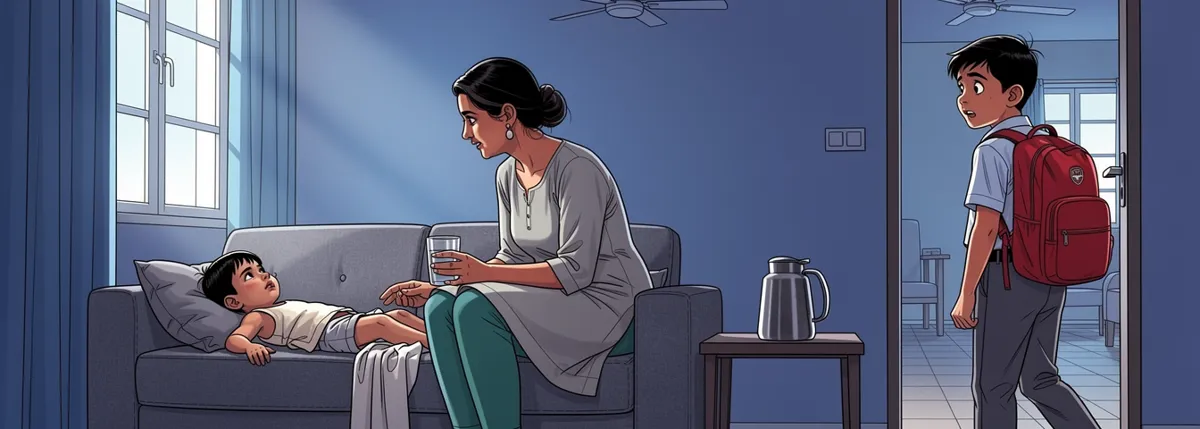
On Monday Veer woke up with loose motions. Veer is Dhruv’s little brother. He went to the toilet, and then again, and again.
Everybody could hear it. Mummy sat with him. Papa phoned the office to say he would be late. Dadi warmed a towel for his stomach.
By Tuesday morning Veer had stopped playing. He lay on the sofa and would not get up. His lips were dry. He was too tired to cry properly.
The running had not changed. Veer had.
The idea
What was happening to Veer? The running was the loud part. But it was not the part that was hurting him.
People who study this have a rule for it.
The idea
Diarrhea kills by dehydration; treat the dangerous part.
Hard words. Here is what they mean.
Think of a body as a jar of water. Every time Veer ran to the toilet, some water left the jar. That is what diarrhea is: water leaving the body faster than it comes in.
The running is what everyone sees and hears. That is the loud part.
The water going down is what harms. When the jar gets low, a child grows weak and sleepy. His mouth goes dry. That is dehydration: too little water left in the body. That is the dangerous part.
They are two different things.
There are two things you could aim at.
You could try to stop the running. That is what a strong medicine promises. But a stopped spout does not fill a jar. The water stays low.
Or you could put water back in, as fast as it leaves. The jar fills. The running goes on for a while, and then it passes.
The sugar-salt drink puts the water back. It does not stop the running. It was never meant to. Treat the dangerous part means: fill the jar.
What people believe instead
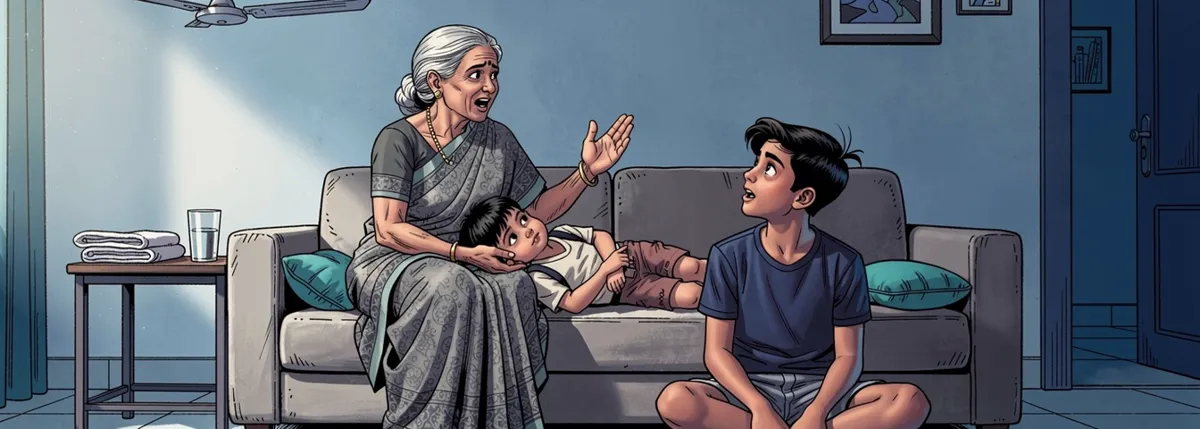
Dadi sat by Veer and held his hand. “He needs a strong medicine,” she said. “Something to stop it. Then he will be fine.”
Dhruv did not argue. Dadi has looked after more sick children than anyone he knows. And it sounded right. The running was the whole trouble you could see.
In Dadi’s picture, the running is the only part. Stop it, and the jar is full again. But a jar does not work like that. Stop the spout, and the water stays where it is. Low.
Read this part twice
Nothing in this chapter is a reason to skip a medicine the doctor gives, or to wait before asking for one. The doctor is the person to ask about any medicine. What this chapter says is smaller. The sugar-salt drink works on the dangerous part, and it does not wait for anything.
The packet, and the phone call
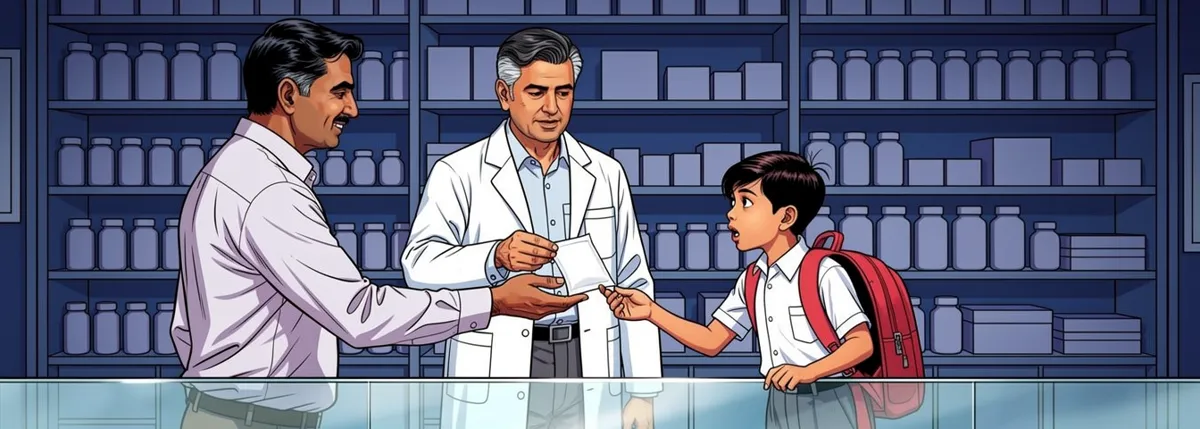
Papa phoned the doctor on Tuesday morning. The doctor did not say a strong medicine. She said: the packet.
Papa and Dhruv went to the chemist after school. Dhruv expected a bottle of syrup. The chemist reached under the counter and put down a small flat packet. Sugar and salt. You mix it in clean water, the way the packet says.
“Keep giving it to him,” the doctor had said. “Sip by sip. Again and again. Even while it is running.”
The drink does not stop the running. It was never meant to. It puts the water back.
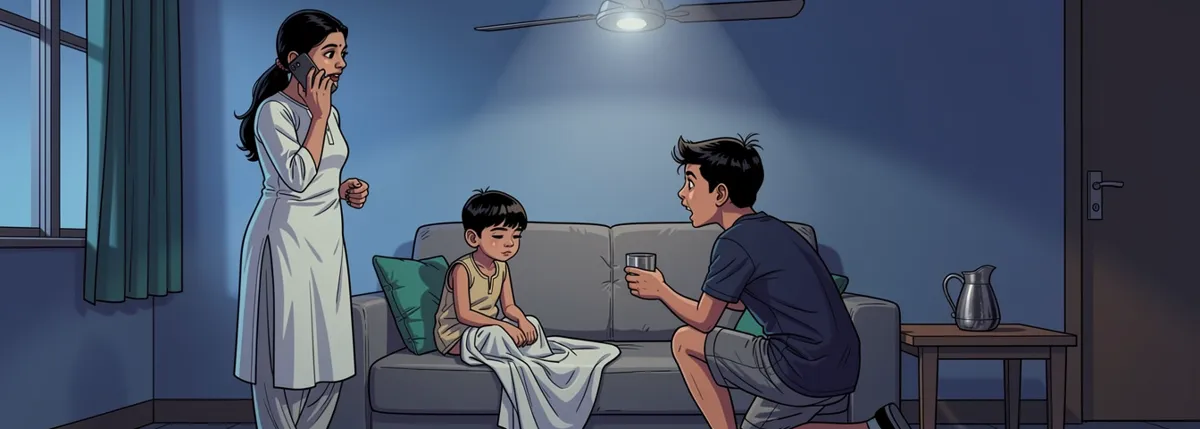
That evening Bua phoned from Jodhpur. She had heard about Veer.
“Give him less to drink,” she said, kindly. “More goes in, more comes out.”
Mummy said thank you. Dhruv held the steel glass and thought about the jar. Bua’s way aims at the loud part. Less in, less running. But the water keeps leaving anyway. With nothing going in, the jar falls faster.
Mummy gave Veer the next sip.
Spot it
1
Your cousin on the train has loose motions. Everyone in the compartment can tell. Which is the loud part? Which is the dangerous part?
2
A friend’s little sister has had it since yesterday. Her family bought a syrup to stop it. Which part does the syrup work on? Which is left?
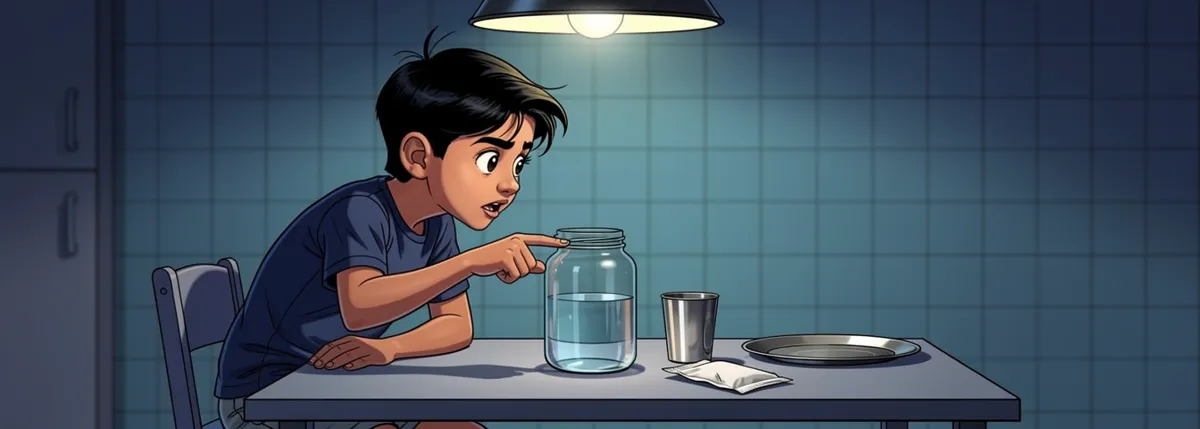
Dhruv runs probes. He asks what would go wrong if. That night he asked: what would go wrong if we only stopped the running? He put a finger on the jar at the water’s level. Stop the spout, and the finger does not move.
So here is the move. When someone has loose motions, point at the loud part. Then point at the dangerous part. They are not the same thing. The packet is for the second one.
Dhruv thought of Uncle Valluvar, who could fit a whole rule into two short lines. Say it in the smallest form it will hold, he would say, and carry it with you. So Dhruv made his two lines. The running is the loud part. The water is the dangerous part. He said them until they stayed.
This week, at home
Find out where the sugar-salt packets are kept in your house. If there are none, ask a grown-up to get some. They are for the dangerous part.
A rule to hold

Here is the rule again, on a page of its own, because it is one to hold.
SAFETY PAGE · A RULE TO HOLD
Diarrhea kills by dehydration; treat the dangerous part.
Read it once more, slowly. Then look at the three jars.
What Dhruv does
He does not wait for the running to stop. He keeps the drink coming, mixed the way the packet says, sip by sip, even while it runs. He asks the doctor. He goes to the doctor if the drink keeps coming back up, if Veer is too sleepy to drink, if there is blood in it, or if it goes on and on. A small baby goes to the doctor at once.
The name
People who study this have a name for the packet’s drink. They call it ORS. Take it one letter at a time.
O is for oral: by mouth, from a cup.
R is for rehydration: the water put back. Dehydration is the water going out. Rehydration is the water coming back.
S is for solution: the packet mixed in water.
The way of thinking behind it, they call ORS logic. Now read the rule again. Diarrhea kills by dehydration; treat the dangerous part. The running is the loud part. The jar is the dangerous part. The cup is for the jar.
The words are new. The jar is not.
Where you will see this next
Next chapter: a danger that makes no sound at all. In the water, and in a crowd.