One stove, four dishes
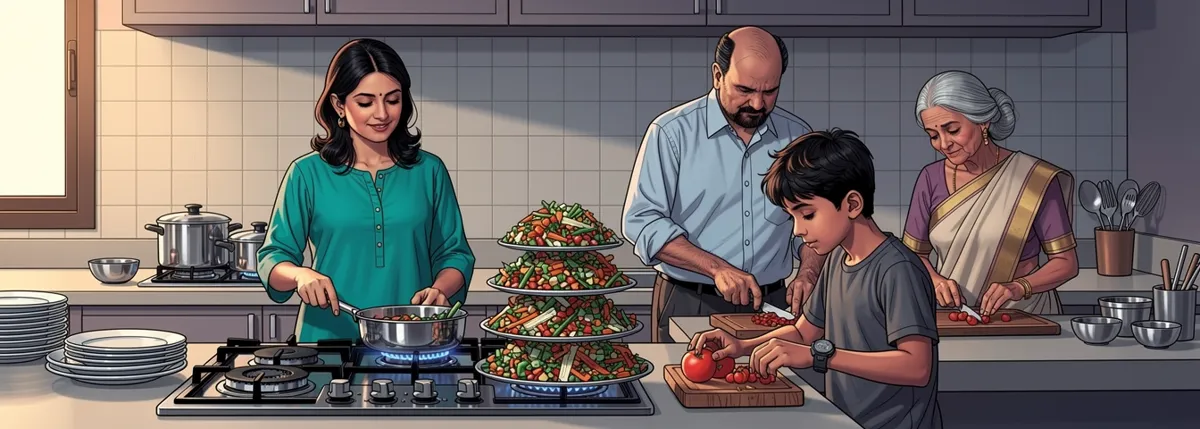
Guests were coming at seven. Amma had four dishes to cook, and one stove to cook them on.
“Everybody help,” said Appa. So everybody helped. Appa chopped onions. Ajji chopped beans. Arjun chopped tomatoes, then carrots, then more onions.
The chopped vegetables piled up in steel plates beside the stove. The pile grew tall. At the stove, one pan sat on one flame, and Amma stirred it. When one dish was done, the next pan went on.
At seven the guests came. The pile was taller than it had ever been. Two dishes were ready.
The idea
What went wrong? Nobody was slow. Everybody worked. The dinner was late anyway.
People who study this have a rule for it.
The idea
The slowest element sets the system’s pace; effort elsewhere is wasted.
Big words. Here is what each one means in the kitchen.
The system is the whole line of work: chop, cook, serve. An element is one part of that line. The pace is how fast the whole line moves.
Each part can do only so much at a time. The stove could cook one pan. That was the narrow part of the line.
The whole line moves only as much as the narrow part lets through. Everything before it piles up. Everything after it waits. The plates at the end of the line waited too. There was nothing to put on them.
Now chop faster. The pile grows. The dishes come no faster. That is what wasted means here. Not lazy. It changed nothing.
Now give the stove a second flame. The narrow part is wider. The whole line moves.
There is one place where effort moves the whole line. It is the narrow part.
What people believe instead

Appa was reading the line as one wide road. Push anywhere on it, and the whole thing moves. “Everybody help,” he said, “and it will go faster.”
Arjun did not argue. His hands were full of onions, and it felt true. Everyone was busy.
But a line is not one wide road. It has a narrow part. Help that lands anywhere else piles up in front of it.
The same shape, twice more
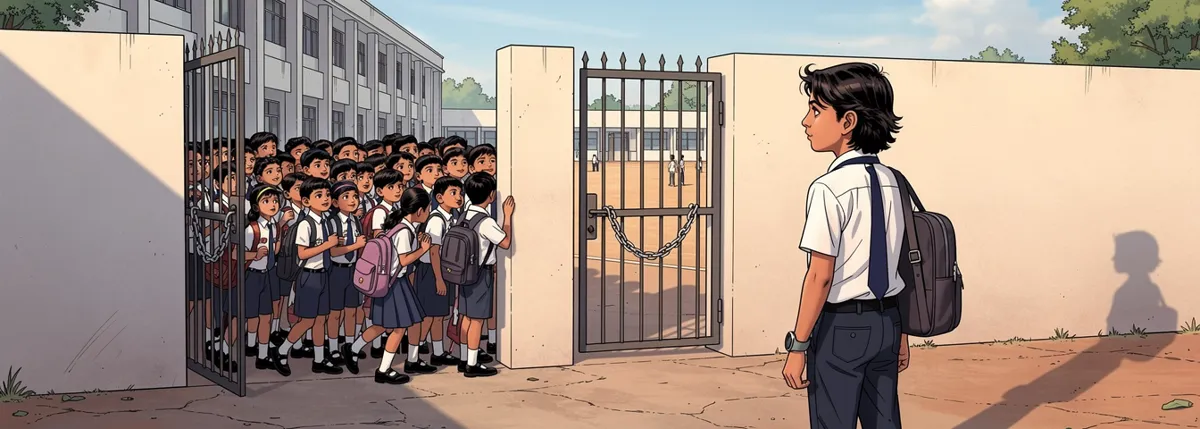
At half past three the whole school leaves at once. The corridors are wide. The playground is wide. The gate is one gate.
Last year the school tried things. Arrows on the corridor floor. Classes leaving one at a time. The corridors emptied faster. The crowd at the gate stayed the same.
Then the watchman opened the second gate. Nobody left a classroom any faster. And the crowd was gone. Arjun stood by the wall and looked at the two gates for a long time.

Four of them made the Science Week chart. Kavya wrote the headings. Sana drew the pictures. Dev coloured them in. Arjun stuck the finished pages on the board.
Colouring takes the longest. It just does. Kavya and Sana finished early and went back to make their pages neater. Arjun sat with a glue stick and nothing to stick. The pages piled up beside Dev.
Dev was not slow. Colouring was the narrow part. When Kavya and Sana picked up crayons, the pile went down.
Spot it
1
A road with three lanes crosses a bridge with one lane. Where do the cars wait? Which part decides how fast they all get across?
2
The lunch bell rings. Forty children wash their hands at one tap. Which part decides how fast the class eats?

Arjun keeps a log. One column says expected. The other says got. That night he wrote: expected, faster. Got, a taller pile.
Before you push anywhere, find the narrow part. It is easy to find. Look for the pile. Things wait just in front of it.
Then push there, and only there.
This week, at home
Find one line of work: the bathroom in the morning, the school bus, the tiffin counter. Where is the pile? That is the narrow part.
The same shape, three costumes

The same shape runs through the kitchen, the gate and the chart. A line of work. One narrow part. A pile in front of it. And help that landed everywhere else, and changed nothing.
Nobody in the three stories was lazy. Not Appa, not the school, not Dev. Effort was not the problem. Where it landed was.
Push at the narrow part, and the whole line moves. Push anywhere else, and you get a taller pile. There is no third place.
Find the narrow part first. Then push there.
Arjun thought of Uncle Kanada, who loved a clean list of parts. What is this thing made of, at the smallest level you can still tell apart? So Arjun listed the kitchen. Chopping. The stove. The plates. Three parts. Then he looked for the pile. It was in front of the stove. That was the part to push at. Parts first. Then the pile. Then the push. He did the same with the gate, and with the chart. Corridor, gate, road. Drawing, colouring, sticking. The pile told him where to look, every time.
The name
People who study this have a name for the narrow part. They call it a bottleneck.
Turn a bottle upside down. The bottle is wide. Its neck is narrow. However much is inside, it comes out only as fast as the neck lets it. The neck is the narrow part of the line.
They also say constraint: the part that holds the rest back.
Now read the line from the second page again. The slowest element sets the system’s pace; effort elsewhere is wasted. The narrow part sets the pace. Effort anywhere else piles up in front of it.
The words are new. The shape is not.
Where you will see this next
Next chapter: an illness that looks like one thing and does its harm by another, and the packet of sugar and salt that treats the dangerous part.