Nobody shouted
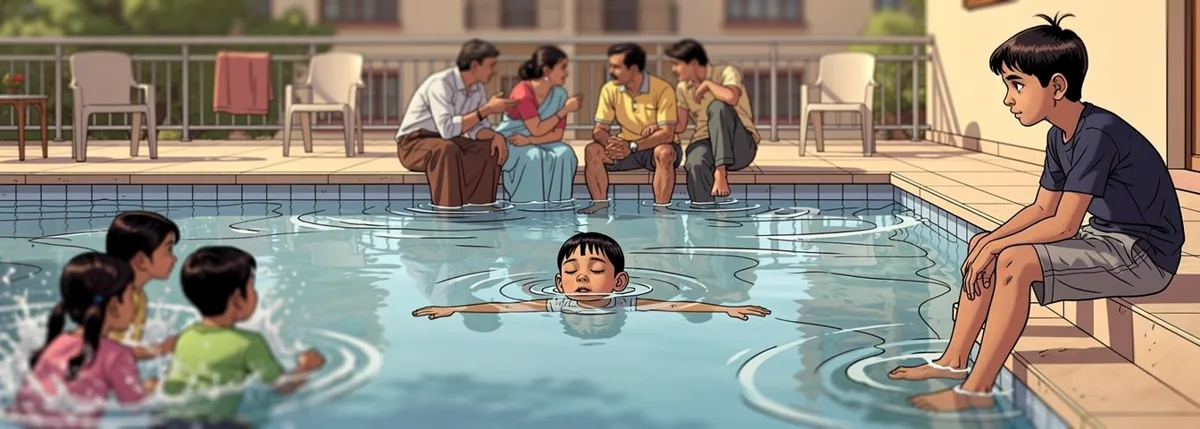
On Sunday there was a birthday at Mamaji’s society pool. The grown-ups sat at the edge, talking. The children splashed in the shallow end.
Dhruv, on the steps, looked up because the splashing next to him had stopped.
Veer was in the water, upright. His head was tipped back. His mouth was at the line of the water, then under it. His arms were flat on the water, pressing down. He was not shouting. He was not waving.
Dhruv pointed and shouted. Papa had Veer out of the water in one pull.
The idea
Veer was fine. He coughed, cried, and asked for cake. But nobody had heard a thing.
People who study this have a rule for it. It has two halves.
The idea
Drowning is silent; crush kills by compression at fixed surfaces — leave early, stay upright, arms braced, move diagonally with the flow, never toward walls.
Hard words. One half at a time.
The first half is about water. A person whose mouth keeps going under has one job: get the mouth up for a breath. The arms press down on the water to lift the head. They do not wave.
The mouth comes up for one breath in. There is no breath left over to shout with. It is quiet, and it is quick.
So look for a position, not a noise. Head low. Mouth at the line. Arms flat. Body upright. No sound. The quiet one.
The second half is about crowds. In a loose crowd a push has somewhere to go. People step aside. In a tight crowd it does not.
The push passes from body to body until it meets something that does not move. A wall. A fence. A shut gate. The people against it are squeezed. Their chests cannot open to breathe in.
Nobody is knocked down by feet. The harm is the squeeze, at the thing that does not move.
What people believe instead

Afterwards Mamaji sat by Veer, wrapped in a towel. “I was right there,” he said. “He didn’t even shout. If he was in trouble he’d have shouted. Kids shout.”
Dhruv did not argue. Mamaji had taught half the society to swim. And it sounded right. In films, the person in the water waves and yells.
In Mamaji’s picture, trouble makes a noise. But a mouth at the line has no breath for noise. Veer had done what a person does. Quietly.
Read this part twice
Nothing in this chapter says a child should go into the water after someone. Dhruv did the loud part: he pointed, and he shouted for a grown-up. The quiet one cannot shout. You can.
The gate, and the platform

In October the family went to the temple fair in the old city. The lane to the gate ran between two walls. As they came in there was room. You could turn round.
Then the lane filled from behind. Papa looked at the wall on the right, and at the people between him and it. “We’re going out,” he said. “Now, while we can still turn.”
He steered them left, through a gap, into a side lane. Dhruv looked back. A minute later there was no gap.
In November they took the train to Bua’s in Jodhpur. The platform was packed. When the train came in, the crowd surged.
An uncle beside them, with a big suitcase, said kindly: “Get to the wall, beta. It’s safe at the edge.”
Dhruv did not argue. An edge sounds like a way out. But a wall is not a way out. It is the thing that does not move. The squeeze is worst there.
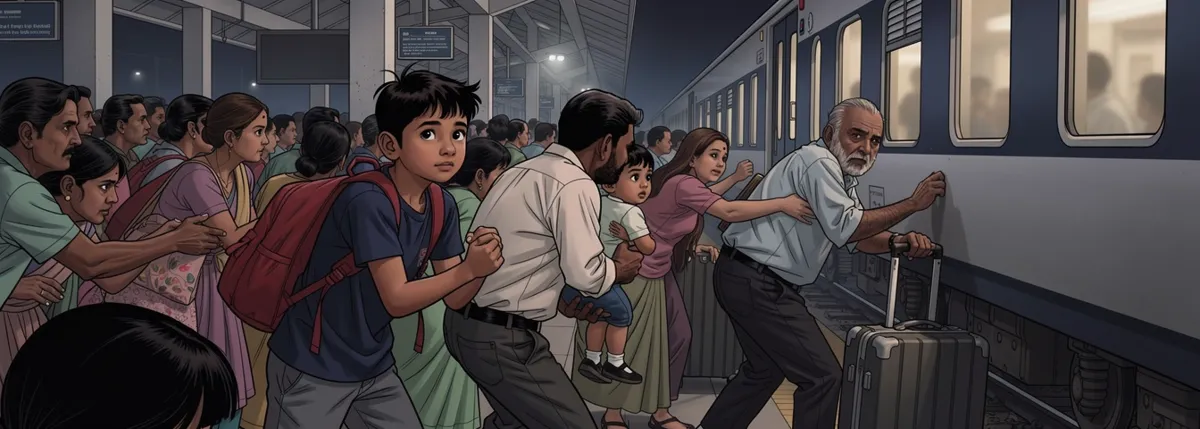
Papa did three things, and Dhruv copied them.
He stayed on his feet. He bent his arms in front of his chest, so the chest kept room to breathe. He did not push straight against the crowd, or toward the wall. He moved across it, at a slant, with the push, toward the open end.
Spot it
1
Your cousins are in the pond at the farm. Three heads in the water. One has gone quiet: head low, arms flat. Which one do you point at?
2
At the fair, the lane ahead is filling up. You can still turn round. Is that the time to leave, or is it too early?

That night Dhruv tried a probe at the table. Breathe in and shout at the same time. You cannot. A shout is breath going out. A mouth at the line only has time for breath in.
So here is the move. Look for the quiet one. Leave while you can still turn.
Dhruv thought of Uncle Sushruta, who sorted things carefully before acting. Two things you have been calling the same kind, he would ask: are they? A quiet child playing, and a quiet child at the line. A full lane, and a tight one. Not the same.
A rule to hold

SAFETY PAGE · A RULE TO HOLD
Drowning is silent; crush kills by compression at fixed surfaces — leave early, stay upright, arms braced, move diagonally with the flow, never toward walls.
Read it slowly. Then look at the three pictures.
What Dhruv does
In the water, he watches for the quiet one: head low, mouth at the line, arms flat, no sound. He points and shouts for a grown-up. He does not go in himself. In a crowd, he leaves while he can still turn. If he cannot, he stays on his feet, arms bent in front of his chest, and moves across with the push, toward the open side. Never toward a wall.
This week, at home
Before you swim next, learn the signs on this page. Ask whoever takes you which part is safe to go in, and swim there only with someone older. Know whose name you shout.
The name
People who study this say it in two names.
The first is drowning: a mouth that cannot stay above the line. Drowning is silent, because there is no breath to shout with.
The second is crush. Not feet: a squeeze. Compression is a push with nowhere to go. A fixed surface is anything that does not move when pushed. Crush kills by compression at fixed surfaces.
The line does not move. Read where the person is against it.
Where you will see this next
Next chapter: a heat that does its harm quietly too, on a day that feels ordinary.