The dry one
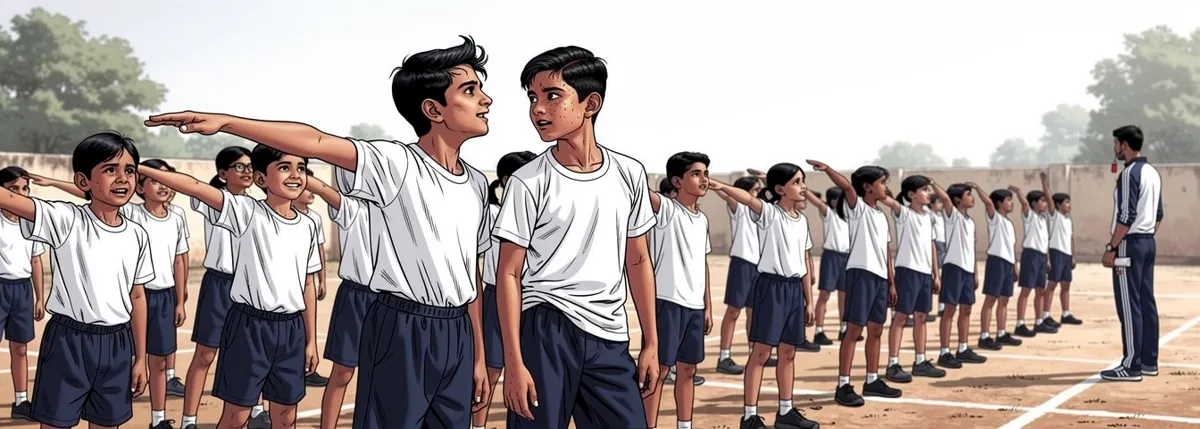
In April, the week before sports day, PT Sir ran the drill at midday. Lines of children on the hot ground. Everyone was sweating. Everyone was loud.
Sameer stood next to Dhruv. At the start he was sweating like everyone. Then he went quiet. Dhruv looked, because quiet was odd for Sameer.
His face was dry. Not a drop. His head was tipped. He said something about a bus, and it made no sense.
Dhruv shouted for PT Sir. PT Sir carried Sameer into the shade and sent for the nurse.
The idea
Sameer was fine by evening. But nobody had seen it coming. He was not the loud one.
People who study this have a rule for it. It has two halves.
The idea
Heat illness progresses silently — confusion or skin that has stopped sweating is the emergency; and overdrinking has its own killer, so drink to thirst, not “as much as possible”.
Hard words. One half at a time.
The first half is about the heat. On a hot day a body sweats. That is the body at work. It shows on everyone, and it is loud.
The sign of trouble is the other way round. The sweat stops. The skin goes dry. Or the talk goes muddled: words that do not fit. Either one is the emergency.
And it comes quietly. Nothing loud happens first. Sameer just got quieter, and drier, and then odd.
The second half is about water. The body asks for water. The asking is called thirst. Drink when it asks. Stop when it stops asking.
Too much water has its own danger. Not the heat’s danger: its own. So “as much as possible” is not the safe amount. To thirst is.
What people believe instead

Afterwards PT Sir sat with Sameer in the corridor. “I was watching Arjun,” he said. “He was sweating buckets. Sameer was dry. I thought dry meant fine.”
Dhruv did not argue. PT Sir had run drills for years. And it sounded right. Sweat looks like trouble. Dry looks like rest.
In PT Sir’s picture, the danger is the loud one. But sweat is the body at work. The one to watch is the one whose sweat has stopped.
Read this part twice
Nothing in this chapter tells you what to do for the child. That is a grown-up’s part. Dhruv’s part was to look at the quiet one, and to shout. Then he stood back.
The sports day
Sports day was in May. The night before, Mummy filled a bottle, and then a second one. “Drink all of it, beta,” she said. “More water is always safer.”
Dhruv did not argue. Mummy had sat up with him through every fever. And it sounded right. Water is good. So more water is better.
In Mummy’s picture, the bottles only help. But too much has its own danger. The safe amount is what the body asks for.
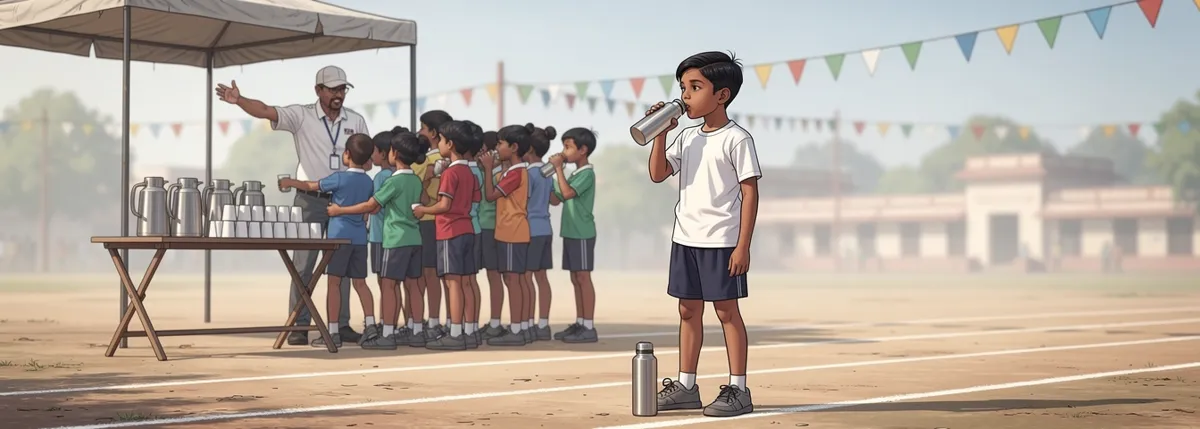
At the ground there was a table of water, and a coach with a whistle. “Drink up!” he called after every race. “As much as you can!”
Dhruv ran his race. He was thirsty, so he drank a bottle. Then he was not thirsty. He put the second one down. The coach called again. Dhruv shook his head and went to watch the next race.

At the junior race the finish line was a wall of noise. Small boys shouting, sweating, jumping.
One boy stood still in the middle of it. Dry face. Swaying a little. He was saying something to nobody, and it did not fit.
Dhruv pointed and called a teacher over. That was his whole part. The teacher took the boy into the shade.
Spot it
1
One boy at the drill is sweating buckets and shouting. One is dry, quiet, saying odd things. Which one?
2
The coach says “as much as you can”. You are not thirsty. Do you drink a fourth bottle?
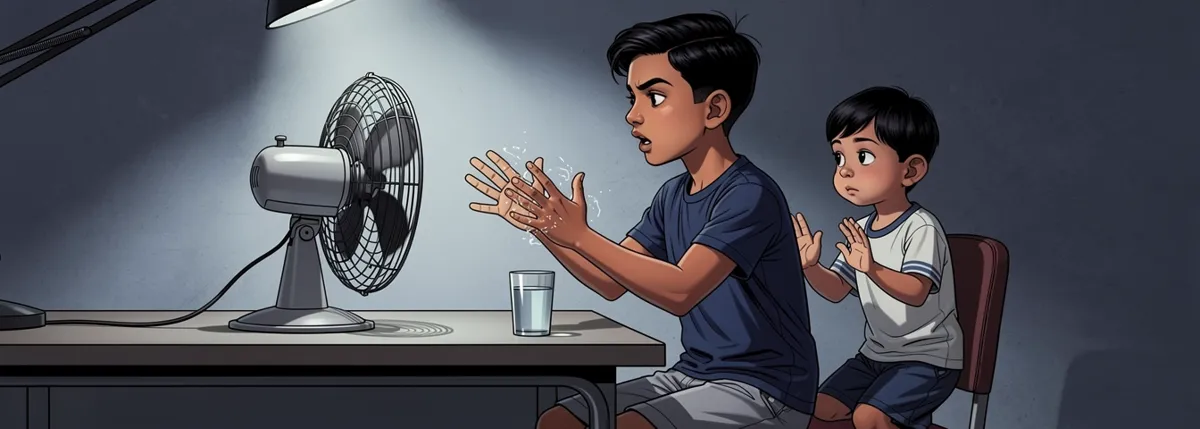
That night Dhruv tried a probe. He wet the back of one hand and held both in front of the fan. The wet one went cold. The dry one did not. So that is what sweat does. When Sameer’s stopped, that stopped too.
The move: look for the dry, quiet one, not the loud one. Shout for a grown-up. Drink when the body asks.
Dhruv thought of Uncle Brahmagupta, who looked before he named. What is actually there, he would ask, before you call it anything? A wet face and a loud voice: a body at work. A dry face and odd words: something else. Look first.
A rule to hold
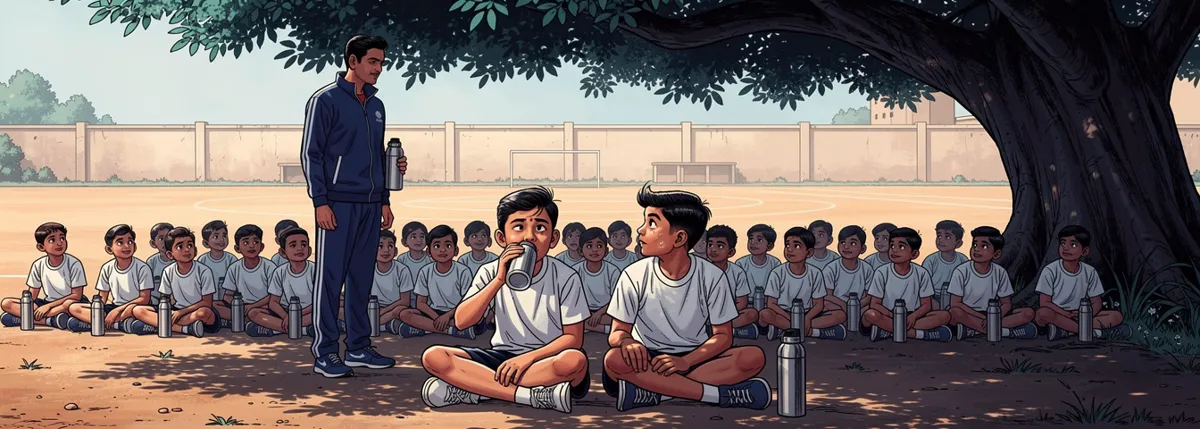
SAFETY PAGE · A RULE TO HOLD
Heat illness progresses silently — confusion or skin that has stopped sweating is the emergency; and overdrinking has its own killer, so drink to thirst, not “as much as possible”.
Read it slowly. Then look at the three pictures.
What Dhruv does
On a hot day he does not watch the loud, sweaty ones. He watches for the quiet one: dry face, odd words, swaying. He points and shouts for a grown-up. He does nothing else himself. At the water table he drinks when he is thirsty and stops when he is not, even when someone kind says “as much as you can”.
This week, at home
On a hot day, watch for the quiet one: dry face, odd words, no sweat. Drink when you are thirsty, and stop when you are not. Tell an adult the moment you see the signs.
The name
People who study this call it heat illness. Heat: the body has got too hot. Illness: it is making the body go wrong. It progresses silently: it gets worse with no loud sign on the way.
The other half has a name too: overdrinking. More water than the body asked for. So the rule says drink to thirst. When the body asks, and not past it.
The sign is on the quiet one. The bottle is for when the body asks. Nobody at the drill used those words. Dhruv just looked at Sameer’s dry face.
Where you will see this next
Next chapter: a film that turns boring halfway, and why the ticket you already paid for should not decide whether you stay.