When the plates are cleared

The term had three weeks left. On the first page of his diary, the second want was the whole English reader.
Dhruv had drawn its road. The block was the phone after dinner. The price was ten pages a night.
He knew both. He had written them down. Two weeks later he had read six pages.
Every night was the same. He meant to. Then it was ten o’clock, and the book was shut.
The idea
The idea
A goal with a when-where-how trigger is completed at roughly twice the rate of a goal alone.
That long sentence says something short. A want with a when gets done about twice as often as one without. A plan is two halves.
The first half says when, and where. Not a time. A thing that happens, and the place it happens in.
The second half says what. One thing you do. Not “study more”. “Ten pages, at the desk.” Put them in one line, and you have a plan.
When the plates are cleared, I take the book to the desk.
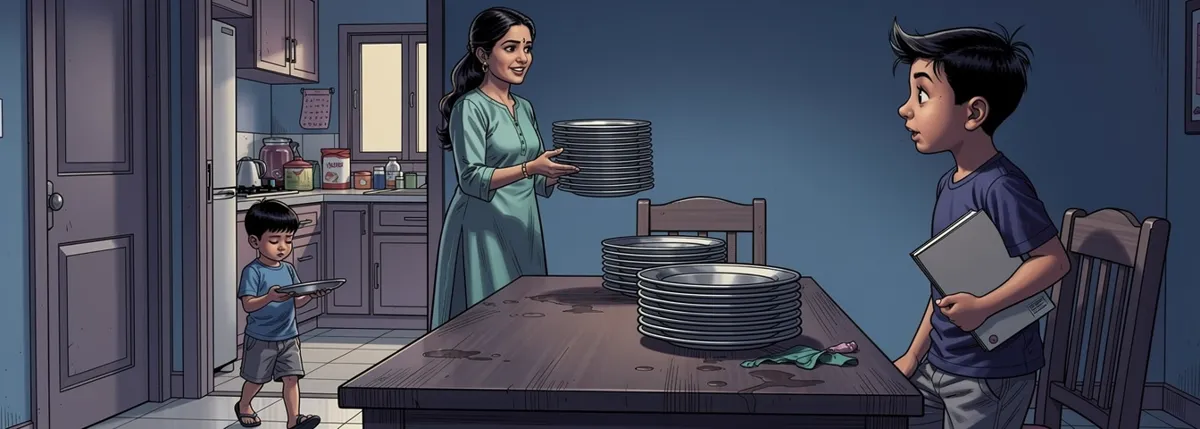
Here is where most plans go wrong. “When I get time” is not a when. Nothing happens then. No plate is cleared. No bell rings.
A when has to be a thing that happens whether you feel like it or not.
In Dhruv’s house the plates were cleared every night at half past eight. Veer carried the small steel ones. Nobody had to remember. So the plates became the when. They came just before the block, every single night.
What people believe instead

Papa laughed when he saw the card. “You don’t need a plan to read a book, beta,” he said. “You need to want it. If you want it enough, you will find the time.”
Dhruv did not argue. He did want it, and over the holidays wanting alone had carried him through a whole comic in an afternoon. But look at where the wanting had to work now. At ten at night. Tired. Phone in his hand, book across the room.
Wanting is what draws the road. It is not what gets you past the block.
Here is why one line does so much. A want with no plan is decided again every night, at the block, at the worst moment.
A plan is decided once. In the afternoon. When nobody is tired.
After that the block asks you nothing. The plates ask. Your hands already know what to answer.
The where does half of it. Dhruv put the book on the desk before dinner, open, the lamp already on. Then the plan had almost nothing left to carry.
The bag by the door

Sameer had the same trouble with the nets at six. His block was the morning. The rush, the dark, the socks he could never find.
So he moved his plan back to the night before. When the light goes off, the bag goes by the door.
Then in the morning there was no plan to follow. There was a bag, in the way, where his feet had to go. The best where is one you cannot walk around.
Spot it
1
You want to drink water through the school day, and you keep forgetting the bottle. What thing happens every day, just before you forget? Write the two halves.
2
“I will revise, sometime this week.” Is that a plan? Say what is missing from it.

On Sunday Dhruv wrote the line on a card and stood it against the lamp.
Then he ran his own test. What would go wrong if I only wrote “I will read more”? Nothing would go wrong. Nothing would happen. There is no moment in the day called “more”.
Here is the move. Take one thing you want and keep not doing. Find something that happens every day, just before the block. Write the two halves in one line. Say it out loud, once. If your when is a feeling, you do not have a plan yet.
This week, at home
Pick one thing you keep meaning to do. Watch your house for a day and find something that happens every evening at about the same time. Write one line: when that, then this. Put the line where you will see it.
Three plans, one shape

The reader was finished four days before the term ended. Three plans, one shape. The book, when the plates are cleared. The nets, when the light goes off. The bottle, when the bell goes for break.
The road is the road you drew last chapter. You at one end. The thing at the other. The block in between. What is new is one small mark at the block. You put it there in advance, on a quiet afternoon, far from the block.
The block did not get smaller. The deciding did.
Dhruv thought of Uncle Valluvar, who could fit a whole thought into two short lines and would not use a third. A plan is two lines too. When the plates are cleared. The book, at the desk. Valluvar never told anyone what to want. He handed them the shortest shape that would hold a thing, and let them carry it themselves. Two lines are easy to carry. That is the whole reason they are two.
The name
The line has a name in this book: an if-then plan. If this happens, then I do that.
People who study this call it an implementation intention. Intention is what you mean to do. Implementation is the doing part. So: an intention with the doing part already written in.
Read the rule again. A goal with a when-where-how trigger is completed at roughly twice the rate of a goal alone.
The trigger is the when. About twice as often is what one small mark at the block is worth.
Where you will see this next
This is the last chapter of this book. Every other model in it shows you something that is true. This one is the one with a hand in it.
Take it into Class 7. The wants get bigger. The two halves do not change.