Two ways to say it

On Monday the school had ten buses out. Eight came in on time. Two were late.
At home time a notice was pinned by the gate. It said: “Eight of our ten buses were on time today.”
Mrs Bano was on gate duty. A parent asked her about the buses. “Two buses were late today,” she said.
Kabir was standing between the two. He heard both.
The parents who read the notice nodded. The parents who heard Mrs Bano frowned. It was the same ten buses.
The idea
Nobody lied. The notice was true, and so was Mrs Bano. They told one fact two ways, and people felt two different things.
People who study this have one line for it.
The idea
Framing — the same fact in different clothes; passive voice hides agents.
Kabir likes to pull a sentence apart. Take it a piece at a time.
First: one fact can be told from either end.
Kabir’s class planted ten pots of seeds on the window sill. Seven came up. Three did nothing.
“Seven of our ten seeds came up!” Kabir told Mummy.
“Three of the seeds did nothing,” his little sister told Dadaji.
Both are true. Each one says a different part out loud, and each one sounds different at the dinner table.
Where you saw this last
The maps in chapter 5 each kept some things and dropped the rest. Here nothing is dropped. The whole fact is there both times. Only the part in front changes.
Second: the clothes change what people do.
Kabir’s scout club has two groups of ten. The leader asked both about a trip to the hills in July.
“Eight of the last ten trips stayed dry,” he told the first group.
“Two of the last ten trips got rained on,” he told the second.
Then he asked who wanted to go. Kabir was in the first group. He put his hand up.
Third: some sentences leave a person out.
In grammar class the teacher wrote a sentence on the board. “Rohan broke the window.” Everyone looked at Rohan, who grinned.
Then she turned it round. “The window was broken.” Nobody looked at anyone.
That second one is the passive voice. Kabir had learned it as a rule for exams. Now he saw what it does. The sentence is still true, and Rohan is not in it.
What people say instead
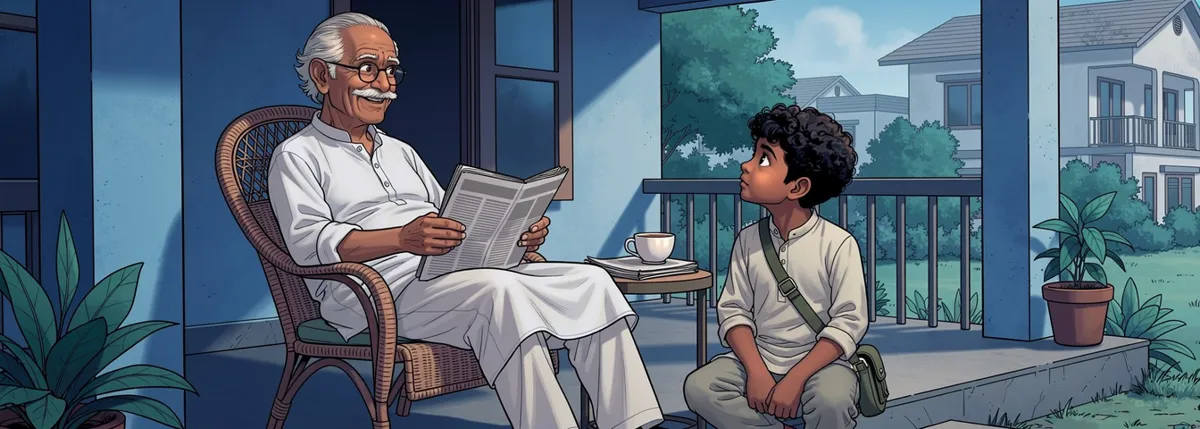
Two newspapers come to Kabir’s house. On Sunday both wrote about the clean-up at the lake.
“Seven of ten ghats on the lake are clean now,” said the first one.
“Three ghats are still dirty,” said the second.
Dadaji read both over his tea. “A paper just tells you what happened, beta,” he said. “Words are only words.”
Dadaji was not wrong. Both papers used the same ten ghats, and neither one made up its number.
Dadaji liked good news too, the same as everybody reading either paper.
Two more

After sports day, the wrong names were read out for three prizes. The next morning a notice went up on the office door. It said: “Mistakes were made.”
Kabir read it twice. Made by whom? The sentence did not say.
The next day the office wrote again: “We mixed up the prize list. We are sorry.” Now the doer was back in the sentence.
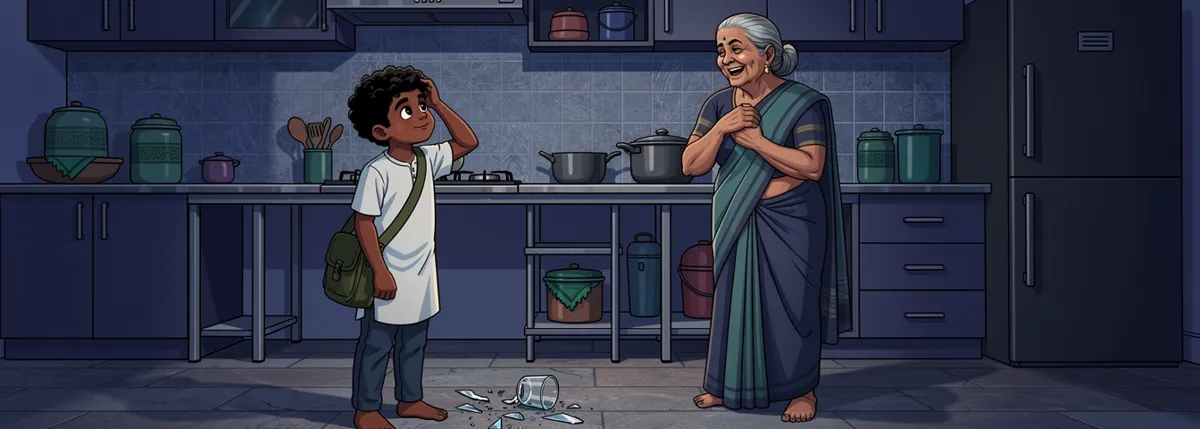
That evening Kabir knocked Dadi’s glass off the counter.
“The glass got broken, Dadi,” he said. Then he heard himself.
“I broke your glass,” he said.
Dadi laughed. “Both are true,” she said. “Only one of them has you in it.”
Spot it
Now try it yourself. Ask what Kabir asks.
1
Two notes went home about the school fair. One said: “Six stalls sold out by noon.” The other said: “Four stalls sold nothing.” What did each note put in front?
2
A line in the class register says: “The fish tank was left open all weekend.” Who is not in that sentence?

Kabir keeps an old pocket dictionary, its spine taped up. He circles in blue ink any word he wants to come back to.
Some words he has circled three or four times. He does not hurry. Neither should you.
One fair, one fish tank
Here is the fair: ten stalls. The first note put the six in front. The second put the four in front. Both notes are true.
The fish tank sentence is true too. But somebody left it open, and the sentence does not say who.
Think back over the chapter. The buses, the seeds, the trips, the two papers: each was one fact, told two true ways. The window, the prize list and the glass: each was told once with the doer and once without.
None of them lied. Each one chose which part to say, and whether to say who.
So when a telling reaches you, ask two things. What did it put in front? Who is not in the sentence?
This week, at home
Listen for one piece of news at home, from anyone. Say it back the other way round. Does it feel different? Then find one sentence this week with nobody in it. Who is missing from it?
Dadi had a story about Khema, a wise woman long ago. People came to her with questions that had only two answers: this, or that. She did not pick one. She would say, kindly, “Wait. Let us ask the question another way first.” Kabir thought: a question wears clothes too.
The name
People who study this call it framing.
Think of a picture in a frame. The picture stays the same. A different frame changes how it looks.
The fact is the picture. The words are the frame.
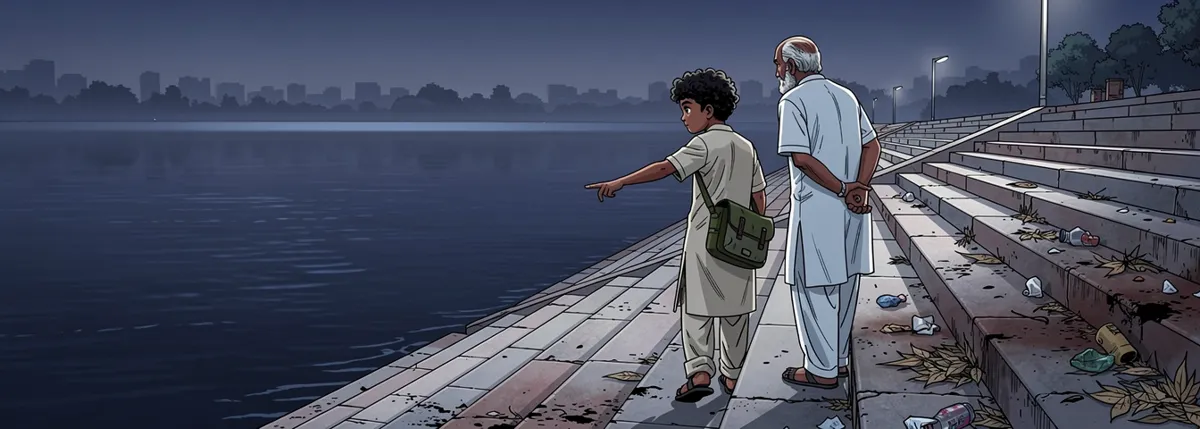
Kabir took Dadaji to see the ghats. Seven were clean. Three were not. They were the same ghats as in both papers.
Where you will see this next
Next chapter: you remember a day. But is what you remember what happened?