Is carrom a sport?
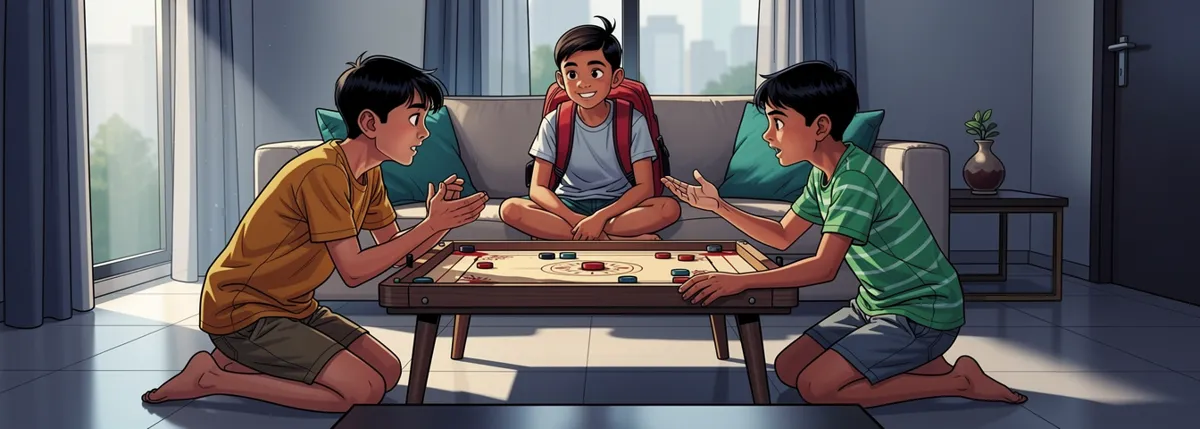
Dhruv’s brother Kunal and their cousin Yash had played carrom since lunch.
Then Yash said, “Carrom is a sport, you know.”
“It is not,” said Kunal. “Nobody sweats at carrom.”
“It has players, rules and a winner. So it is a sport.”
They argued till the tea came. Dhruv listened from the sofa.
Both boys know how carrom is played. Neither has a fact wrong. Their loops just stop in different places.
The idea
Kunal and Yash know the same things about carrom. You flick a striker on a board. You need a steady hand. Nobody runs.
What they do not share is the word sport.
People who study arguments have one line for this.
The idea
Many arguments are about words, not the world — spot the verbal dispute.
So there are two kinds of argument. Take them one at a time.
Some arguments are about the world.
Last week a storm came in the night. Yash says the lights went out. Kunal says they never did.
At most one of them is right. Mummy lit the candles that night, so she can settle it. The lights did go out.
Other arguments are about a word. Look at carrom again, with both loops over the same games.
The boys agree about running and cricket. They agree about snakes and ladders. They part only at carrom and chess.
Each boy draws the line of the word sport in a different place. Where you draw that line is your definition of the word.
Dhruv tried something. He gave each loop its own words.
Kunal means a sport you sweat at. Yash means a game of skill.
Is carrom a game of skill? Yes, say both boys. Do you sweat at it? No, say both boys.
Nothing about carrom changed. Only the words did, and the argument was gone.
What people say instead

That evening Papa and Chachu argued too. Is Ajmer near Jaipur?
“Of course it is near,” said Papa. “We go there and back in a day.”
“Near is the market,” said Chachu. “Near is Amer.”
Dadaji smiled at Dhruv. “One of them has the facts wrong,” he said. “Let them argue, and the truth will come out.”
Often that is true. This time the words disagreed.
Dhruv sat by his chair and listened.
Both brothers know the train to Ajmer takes two hours. Both know the road. They agree on every fact. They mean different things by near.
No new fact would end this one. A map would not help, and neither would a clock.
Two more

At school, Dhruv and Gauri watched the girls’ match.
“Riya is the best batter,” said Dhruv. “She scores the most runs.”
“Sana is the best,” said Gauri. “She never gets out early.”
Riya hits hard and gets out fast. Sana blocks and waits.
Both of them are right about Riya. Both are right about Sana. They each meant something different by the best.

At breakfast, Yash held up a tomato. “This is a fruit,” he said. “It grows from the flower, and it holds the seeds.”
Dhruv’s sister Sai, who is nine, laughed. “A fruit is sweet. You eat it after lunch.”
Nobody in the kitchen thinks a tomato is sweet. Everyone knows it has seeds. They agree about the tomato. They put the word fruit in different places.
Spot it
Here is one more. Try it the way Dhruv would.
1
At lunch Kunal pushed his poha away. “Poha is not a real lunch,” he said. Yash said it is. Is this about the world, or about a word?
2
What would you ask each of them, to find out where his loop stops? Would a new fact about poha settle it?
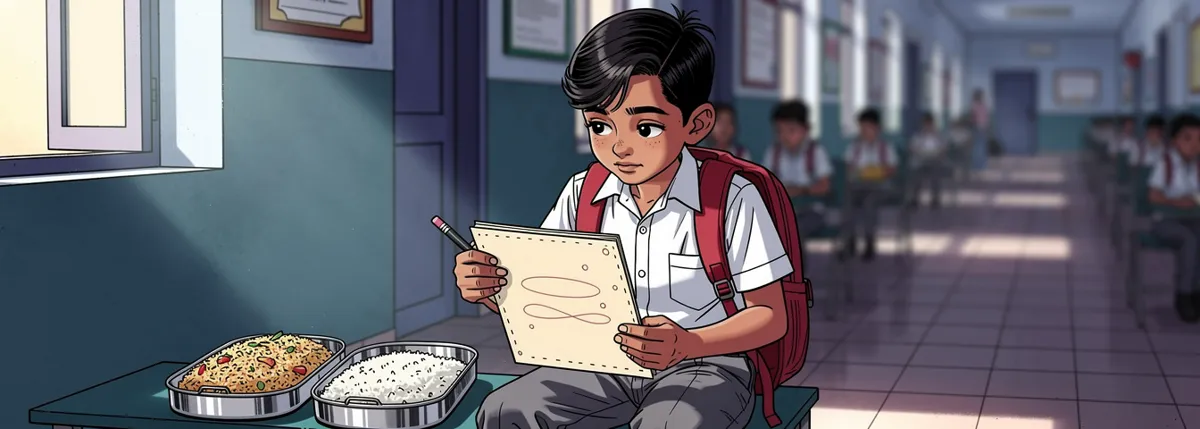
Dhruv carries a small pocket atlas. Its back page is blank, and that is where he tries things out. He puts the things in a row, and gives each person a loop.
One tray, two loops
Here are the loops. Both boys agree about the biscuit, the banana, and the dal and rice. The whole argument is one bowl of poha.
So it is about a word. Ask Kunal what he means by a real lunch. Ask Yash too. Give each meaning its own words, and see what is left.
Think back over the chapter. Carrom, near, the best batter, the tomato, poha. Each time, two people knew the same facts and drew one word’s line in different places. Only the lights were about the world, and someone who was there could settle it.
Nobody in this chapter was silly, and nobody was lying. They were using one word for two things.
This week, at home
Listen for an argument that will not end. Draw the things it is about in a row. Loop what each person means by the word. Where do the loops part? Now give each loop its own words. Is anything left to argue about?
Long ago, a thinker called Dignaga spent his life on what words pick out. Faced with carrom, he would have asked: what kind of thing is this, really? Does the word pick out anything exact? Dhruv tried it on his own word, sport. His loop came out smaller than he expected. Running and cricket stayed in. Chess did not.
The name
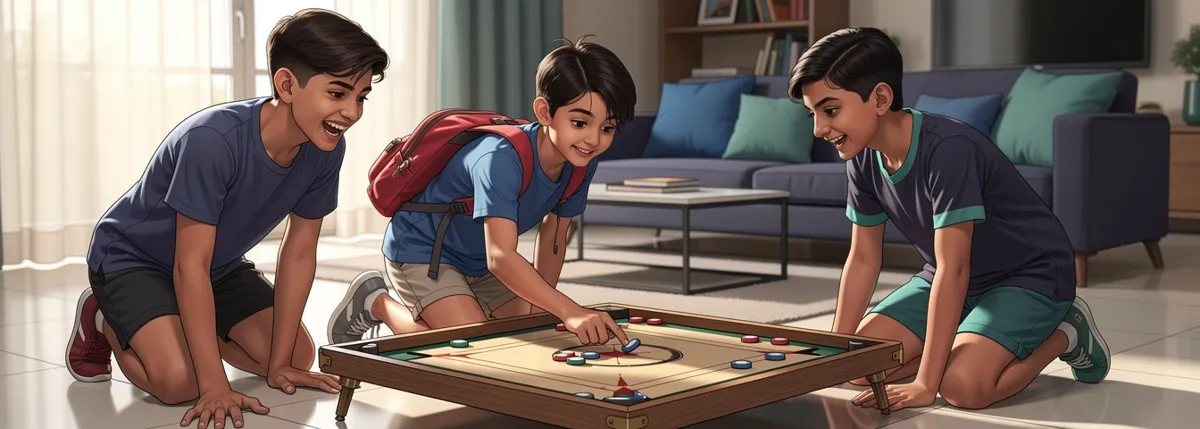
People who study this have a name for it. When both sides agree on the facts and argue about what a word means, that is a verbal dispute.
Verbal means made of words. A dispute is an argument.
Grown-ups have them too, in shops, in offices and on the news.
A verbal dispute is not a silly one. Words matter. It just helps to know which kind of argument you are in.
The boys still play carrom every Sunday. They no longer argue about what to call it.
Where you will see this next
Next chapter: a lock, a password, and the person who wants to get past them.