How the World Works(working title)
This book is for your child, from Class 6 to Class 12.
The book is planned in full, but no chapter is written yet.Who it is for
This book is for your child, from Class 6 to Class 12. There is one part for each class, written at that class’s own reading level — the first for an eleven-year-old, the last for a seventeen-year-old. Your child is the reader; nothing in a chapter speaks to you. Nothing is assumed beyond their own school year, so a child can start at the part for their class without having read the earlier ones.
The problem it answers
School teaches the subjects, but leaves out how the world actually works. No board’s syllabus in India carries the handful of ideas that explain how people, chance and systems behave. People respond to what pays them, including whoever advises them. An unusually good or bad result is partly luck, and the next one drifts back. An action has effects beyond the first one. A cost already paid should not decide what comes next. Adults without these ideas buy them back later, from the self-help shelf.
What changes for the reader
Your child learns to see these ideas at work in real life. A child who finishes a part can meet a new situation and name the idea inside it. In the bad test after the great one, they see results drift back towards normal. They ask who pays the person giving the advice. They notice a fee already paid being used as a reason to continue. By the last part, they can also work five of the ideas with numbers. The book makes no promise about marks.
What is inside
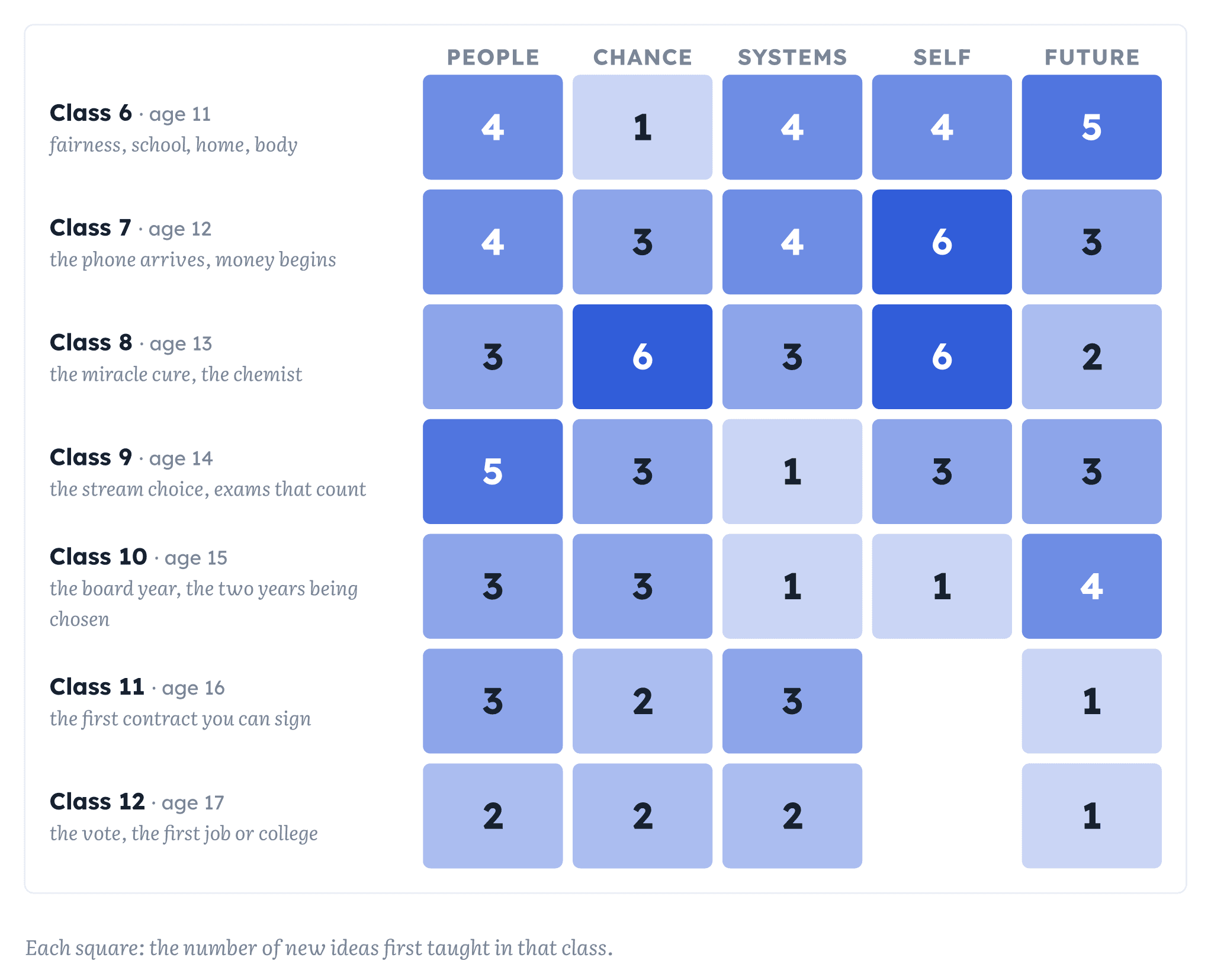
Five units, every class.
People: incentives, fairness, persuasion, markets and contracts. Chance: probability and evidence, what counts as knowing, and how sure to be. Systems: feedback, growth, bottlenecks, and what a phone’s feed is built to do. Self: the body, perception, memory and training. Future: your child’s own choices, and what those choices do to their later self — limited to what a child that age can actually act on.
The chapters that keep your child safe.
Some chapters are safety rules, taught as plainly as everything else. They cover oral rehydration, that drowning is silent, heat illness, a crowd crush, never sharing a one-time password, how a chemist’s shelf is arranged, and the contract a minor cannot sign. Each is taught once, then restated on a single page two classes later, in a new situation.
Seven classes, each its own year.
Class 6 is fairness, school and home. Class 7 is the phone and money. Class 8 is the chemist and health. Class 9 is choosing a stream. Class 10 is the board year. Class 11 is the first contract your child can sign. Class 12 is the vote and the ideas worked with numbers. In all, 127 chapters; an idea taught once returns later.
What a page looks like
Each chapter opens with a situation your child already knows. It is drawn, and lets your child recognise the idea inside it before the chapter names the idea and states the belief it replaces. Two more situations follow, with a line on where the idea returns later. Each chapter closes with one thing to do at home that week — such as asking the chemist what the line on a packet means. It is always a question the child asks, never a correction they deliver to an elder.
What it is not
This is not a civics book, and not general knowledge. It is also not a study-skills book — that is a separate book, How to Study. It carries no practice questions, no marks, and no alignment to any board. There is no parent’s guide inside it, and no stories of toppers.
Where the book stands today
Status as of 19 September 2026. The book is planned in full, but no chapter is written yet. As of September 2026 the syllabus is complete: every chapter for every class is listed, each with the idea it teaches and the belief it replaces. The title may change. No release date or price has been set.