QUILL · the text Creator

One claim. Four voices.

QUILL is one function: compose(atoms, knobs) → cells. An atom fixes what is true. The knobs decide who is saying it, and to whom.

Below, a single locked atom from the Class-9 AI lattice is written four ways. Nothing about the claim moves — only the voice. Then the same atom is walked through the pipeline that produced it, stage by stage, with the real files.

The register canon

Held constant: the claim. Varied: everything about who says it.

If the four passages below teach the same thing and still sound like four different people, the voice layer is real.

The atom · claim (verbatim, locked)

A generative model learns a statistical distribution over training data; at generation time it samples one plausible output from that distribution given a prompt. It does not retrieve from a database — every output is constructed fresh by sampling.

the atom behind generative AI's core mechanism

the claimlocked
The Teacher
The CSAT Coach
The Adult-Remediation Voice
Priya (the Wondering Voice)
The claim — locked, unchanged
The Teacher
The CSAT Coach
The Adult-Remediation Voice
Priya (the Wondering Voice)
One claim, unchanged at the hub. Four spokes out — one shipped, three composed to make the contrast visible.
The TeacherShipped · locked

The honest builder who figured it out and is showing you — a fellow investigator a few moves ahead, not a lecturer at a board.

grade: g9english: L2-tier2edition: school-g9

Picture the machine that writes your poem as a clerk in a record room. Somewhere inside, in a labelled file, your poem is lying finished, and the clerk’s whole job is to find it. Most of us carry some version of this picture — where else would the poem come from?

Test it. Ask for the poem twice. Two different poems come back. A clerk pulling a finished page from a file would bring the same page both times. So there is no file.

Then what is inside? Think of the man at the tea stall you cross every day after school. Thirty years at that counter, and every kind of talk has passed in front of him — results day, match day, bandh day. Has he memorised even one of those conversations? Not one. But say two sentences to him and he can tell where the third is going. Not because he has heard your third sentence before — because thirty years gave him a feel for what follows what.

A generative model holds exactly that kind of feel, learned from everything it trained on — not stored answers, but a statistical sense of what tends to follow what. Give it a prompt, and it draws one plausible reply from that sense, built fresh, word by word. Nothing is fetched from storage — every output is built at the moment you ask for it.
verbatim, quoted in full from a shipped Class 9 chapter’s prose cell
The CSAT CoachComposed for this page

The examiner-whisperer who has read every paper. Names the trap out loud, no warm-up, exam-room second person.

grade: adultenglish: L2-tier2edition: upsc

“Generative AI retrieves its answer from a large database.” Read that option again. It sounds right. It borrows the syllabus’s own words, and it is the picture most candidates carry into the hall — which is exactly why it is on the paper.

It is wrong, and the examiner knows how many of you will tick it. A generative model stores no answers. It learns a distribution — a statistical sense of what tends to follow what — and at generation it draws one plausible output from it.

The tell is one word: retrieves. Retrieval means the answer existed before the question was asked. Nothing existed here until you prompted it. So the rule is flat, and it will hold across every phrasing they try: when an option says the machine found the answer, strike it. The machine made the answer.

voice proven on a live UPSC reading-comprehension chapter (876 lines)
The Adult-Remediation VoiceComposed for this page

Speaks to an adult failed by a system, not to a slow child. Names the false ceiling, then builds from what the reader already does competently.

grade: adultenglish: nativeedition: master

If you have kept away from these tools assuming there is a technical layer you missed, there isn’t one here. The picture you are probably carrying — the machine looks the answer up somewhere — is not a gap in your education. It is where nearly everyone starts, and it is simply wrong.

Here is what actually happens. The model has read an enormous amount of text and kept none of it word for word. What it kept is a feel for how such writing tends to go — the same way you can tell a letter from your bank apart from a letter from a friend, instantly, without being able to name the rule you used.

Ask it something and it builds a reply out of that feel, one likely word after another. Nothing was stored. Nothing was found. It was made, while you waited.

voice proven on the adult-math fractions chapter (§1–3 owner-passed)
Priya (the Wondering Voice)Composed for this page

A peer, not a teacher. Voices wonder before method, surfaces her own naive reading first, then revises it in the open — and never performs certainty.

grade: g6-7english: nativeposture: peer-learner

I asked it for a poem about the monsoon, and it wrote me one. Then I asked again, and the poem was different.

That puzzled me for a while. If it had a poem kept somewhere, surely the same one would come back both times? So where was the first poem, before I asked for it?

I think the answer is: nowhere. It wasn’t anywhere at all. The machine hasn’t kept poems — it has kept a sense of how poems tend to go, the way I can hear that a line is missing a beat without stopping to count. When I ask, it makes one, one likely word after the next.

Which means the poem I got is not a poem it had. It is a poem it did. I am still deciding how I feel about that.

no composed book prose exists yet — posture owner-confirmed for the English 6–8 series

Read the badges. Only the first card is book text that shipped — it is quoted verbatim from a locked expression file. The other three are composed here, on this claim, to make the contrast visible; each names the live file where that voice is already proven on its own subject. Two of the four voices carry a WHO that is owner-ratified but has no chapter behind it yet.

The knobs · a second axis

Same voice, same claim, three readers.

Voice is only one knob. Hold voice: The Teacher fixed and turn grade instead — the person stays the same; the crouch changes. Nothing is talked down: simpler words, never smaller respect.

g6-7
g9
g11-12
simpler wordingmore technicalsame claim — unchanged
The same claim beneath every register — only the wording slides from simple to technical.
grade: g6-7Composed for this page

Ask it for a poem. It does not go and find one, because there is no poem to find — not in a drawer, not in a list, nowhere. What it has is a feel for how poems go. So it builds you one, word by word, while you wait. Ask twice and you get two poems. Made things vary.

grade: g9Shipped · locked

A generative model learns exactly that kind of feel, built from everything it trained on — not stored answers, but a statistical sense of what tends to follow what. Give it a prompt, and it draws one plausible reply from that sense, built fresh, word by word. Nothing is fetched from storage — every output is built at the moment you ask for it.

grade: g11-12Composed for this page

What the model holds is a learned distribution over its training corpus — not an index into it. Generation is a sampling operation: given a prompt, it draws one plausible completion. The output is constructed, and the construction is stochastic. That is the whole reason one prompt admits many equally valid answers, and why plausibility is not truth.

The types of text

A page is not one kind of writing. It is six.

The atom declares which beats it owes the reader; QUILL writes each one in its own form. Every cell below is verbatim from the same atom’s shipped file — one claim, six different jobs.

prosethe voiced teaching beat — carries the claim

Picture the machine that writes your poem as a clerk in a record room. Somewhere inside, in a labelled file, your poem is lying finished, and the clerk’s whole job is to find it… Then what is inside? Think of the man at the tea stall you cross every day after school.

figurerender: from-recipe — structure comes from the atom itself
kicker: “training → distribution → sampling”
Training dataLearned distributionSample one output
not retrieval — the model holds no answer database; every output is a fresh draw from the distribution

QUILL writes no figure text here. The atom already carries the structure; the cell is three lines of YAML pointing at it, and ETCH draws it.

worked-contrasttwo cases, one variable

retrieval vs generation

WeakThe clerk in the record room. Send him for a page and he walks straight to the file where it has always sat, and brings back that very page, unchanged. Nothing about the file moves between one request and the next. The page existed before you asked; finding it, never making it, is the whole of his job.
StrongThe tea-stall man. Put a question to him about a conversation he has never actually heard. He does not go quiet — he answers, fluently, out of thirty years of feel for how such talk usually runs. A generative model works the same way. It holds a learned distribution over everything it trained on, and at generation time it samples one plausible answer that fits your prompt. Run the same prompt again and the answer can come back different, and just as plausible — each pass is a fresh draw from that distribution, never a repeat visit to a file.
drilla stepped procedure, exam-facing

How to explain the generative mechanism in the exam

  1. Name what the model holds. Not a database of stored answers. A learned statistical distribution — a sense of what is plausible, not a filing system of what is true.
  2. Name what happens at generation time. It samples. Given your prompt, it draws one plausible output from that distribution.
  3. Rule out retrieval, directly. Retrieval means the answer already existed somewhere. Generation has no stored page to find.
  4. State the consequence. Each run is a fresh draw, not a lookup. And a plausible answer is not automatically a true one.
repthe reader produces — the book does not

Close this page. In one sentence, explain how a generative model produces its output — without using the word database, and without saying look up. Then check your sentence. Does it say the model samples, draws, or builds an answer from a learned distribution? If it still describes something being found rather than made, write it again.

objectionthe misconception, said out loud, then answered

“Generative AI retrieves the answer from a large database.”

It holds no database. There is no drawer anywhere holding your answer, ready to be found — that is the records-room picture, and it is the wrong one here. What a generative model holds is a learned distribution: a statistical sense, built from training data, of what tends to follow what… That is exactly why asking the same question twice can give two different, equally plausible answers — each run is a new draw, not a repeated lookup.

The reader never sees the seams. These six land on the page as one continuous read. The forms exist so that each idea is met once per path — the reader who studies, the reader who skims, the reader who revises the night before, and the reader who only looks at the pictures.

The process · the stage

What comes in, what changes, what goes out.

QUILL is one stage of a pipeline, and it owns exactly one job: turning a settled claim into reader-calibrated prose. It does not decide what is true — that is settled upstream and locked before QUILL sees it. It does not decide what the page looks like — that is downstream.

the field
LATTICEAtoms. What is true, what it depends on, what a reader must be able to do.
atoms
QUILLThe pen. Writes each atom into a voice, for a named reader.
ETCHDraws the figures the atoms carry.
cellsfigurescellsfigures
PRISMAssembles one edition's cells into pages.
an edition
Every hand-off is a file on disk — settled, locked, then handed on. No stage re-opens what an earlier stage settled.
Inside QUILL · compose(atoms, knobs) → cells
atoms[]+voicegradeenglishlookpresentation planauthorgatescells

The knobs are read, never re-derived — they are pinned to disk on the book’s row before a word is written. The plan is assembled deterministically and proposes; the author may deviate, but only with a stated reason.

The process · the same pipeline, for real

One atom, walked end to end.

The same atom the four voices shared above — every panel below is the real file on disk, not an illustration of one.

In

The atom. Settled upstream, locked before QUILL reads it.

# lattice/ai-genai-mechanism.yaml
- id: ai-genai-mechanism.generative-mechanism
  role: concept
  claim: >
    A generative model learns a statistical distribution over training
    data; at generation time it samples one plausible output from that
    distribution given a prompt. It does not retrieve from a database —
    every output is constructed fresh by sampling.
  visual:
    structure: {type: sequence, kicker: "training → distribution → sampling"}
  assess:
    trap: "Generative AI retrieves the answer from a large database."
    real: "It holds no database… the output is constructed, not fetched."
  body:
    - {id: contrast, kind: worked-contrast, axis: "retrieval vs generation"}
    - {id: drill,    kind: drill, steps: 4}
    - {id: try,      kind: rep}
    - {id: doubt-database, kind: objection, of: database-confusion}
  prereqs: [ai-genai-mechanism.chapter-frame]

Note what the atom already decided. The claim, the misconception to confront, the figure’s structure, and the four beats the reader is owed. QUILL cannot add or drop any of them — it can only write them.

That last line — prereqs: — is a graph edge. Every atom in a chapter declares what a reader must already hold, and the whole chapter resolves into a dependency graph before a word is written. See a full chapter graphed, hover-by-hover →

Knobs

Read off the book's row. Never re-derived — re-deriving them is the known failure.

# expression/ai-genai-mechanism.school-g9.yaml — front matter
voice:    the-teacher       # the WHO
register: school-g9         # the edition PRISM assembles
grade:    g9                # the crouch
english:  L2-tier2          # the accessibility floor
reader:   CBSE Class 9 AI (417) student
lang:     en                # Indian Standard canon
Plan

Assembled deterministically, before any writing. It proposes; the author resolves.

# expression/ai-genai.school-g9.plan.yaml — section 2
heading: "How generative AI works"
presentation:
  genre:  expository-concept  # rel=0 fallback, set by kind — recorded, not hidden
  lead:   invent-it           # pose the engineer's constraint before the mechanism
  rhythm:
    - {atom: generative-mechanism, type: counterintuitive, rhythm: tension-arc,
       note: "opener — builds the wrong (retrieval) picture, breaks it"}
  arc:    {open: "what would YOU build to answer in a new way each time?",
           peak: probabilistic-sampling, close: synthesis-callback}
  routing:
    - {claim: generative-mechanism,
       spine: "made, not found — every output is a fresh draw",
       figure: y, doing: "drill + rep + objection", trap: database-retrieval}

This is the movement controller. The knowledge is counterintuitive, so the rhythm is a tension-arc: build the wrong picture, then break it. That is why the shipped prose opens with a clerk in a record room and then takes him away. The variety guard forbids the next section from doing it again.

Compose

The only step where a model writes. It authors inside the plan, never around it.

earn-onceEvery move lands once, at the load-bearing moment. A move on a schedule is the machine wearing the voice's clothes.
handlesN01 clerk-at-the-cabinet, N02 tea-stall-man — registered figures pulled from the World Bible, never invented at the desk.
incumbent ruleAuthored fresh from the claim. Prior prose may be consulted for shape, never as input — translation is how voice drifts.
Gates

Mechanical first, then an independent reader. The author never marks their own work.

rigor guard G1–G5Never soften a caveat, swap a precise term, trim a list, narrate a figure from memory, or dissolve a worked example. The weave is authored; the claim is honored.
readability_mechThe reading-grade floor and the wall-of-text floor — a paragraph carries one move, ~40–80 words.
plan-conformanceLead honored, rhythm honored or resolved, arc present, routing landed. A silent deviation is a defect; a stated one is not.
correctnessAn independent agent, never the author. Then the owner's eye on the render — which is the gate that actually decides.
Out

Cells. Six beats from one atom, ready for PRISM to assemble into any edition.

prosefigureworked-contrastdrillrepobjection

Picture the machine that writes your poem as a clerk in a record room. Somewhere inside, in a labelled file, your poem is lying finished, and the clerk’s whole job is to find it. Most of us carry some version of this picture — where else would the poem come from?

A generative model holds exactly that kind of feel, learned from everything it trained on — not stored answers, but a statistical sense of what tends to follow what. Give it a prompt, and it draws one plausible reply from that sense, built fresh, word by word.

The claim never moved. Compare the serif above to the YAML at the top of this spine — same assertion, every caveat intact. Everything that changed is the weave. That is the whole contract: the weave is authored; the claim is honored.

The process · a different topic, taken all the way

It doesn’t stop at cells — here’s one that reached a page.

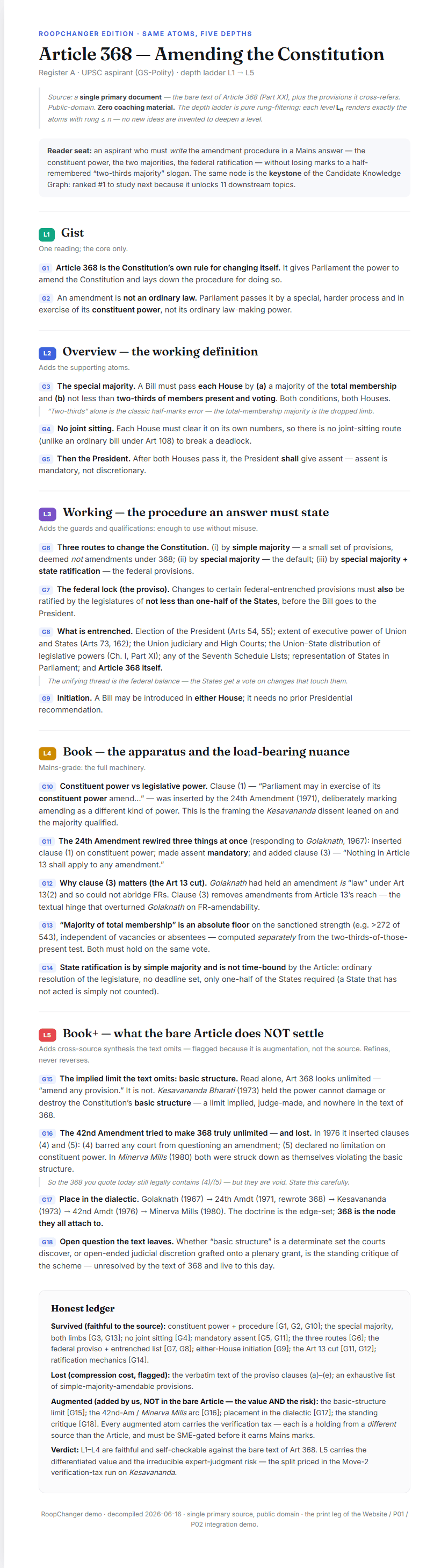
The genai spine above stops at the six cells QUILL hands to PRISM. A different topic — Article 368, the Constitution’s own amendment procedure — is assembled far enough to show the other end: the same kind of atom file, and the actual page PRISM built from it.

the Article 368 topic's skeleton file
topic:
  id: article-368
  subject: polity
  dimensions: [clarity, explanation, background, implications, connections]
  advance_bar: [clarity, explanation, background]   # 75-floor
  mastery_bar: all                                  # 90-ceiling

items:
  - id: I-MCQ2
    dimension: implications
    kind: mcq
    answer: a   # the headline trap: "amend ANY provision" reads as
                # unlimited, but Kesavananda's basic-structure limit
                # (NOT in the text) caps it

Follow that answer note onto the page. It is the same claim as atom G15 in the render at right — “the implied limit the text omits: basic structure”. The atom decided the claim; PRISM decided which depth level it lands on.

The real rendered page for Article 368: a depth ladder L1 through L5, each atom tagged with its id, ending in an honest ledger of what survived, was lost, and was augmented.

This is the voice layer. See the whole learning loop it writes for.

How a lesson works →

Gold badges mark text quoted verbatim from a locked, shipped file. Dashed badges mark prose composed for this page to make the contrast visible — honest demo, not shipped output. The eight-voice exploration that selected this register stays internal by design and is not shown here.