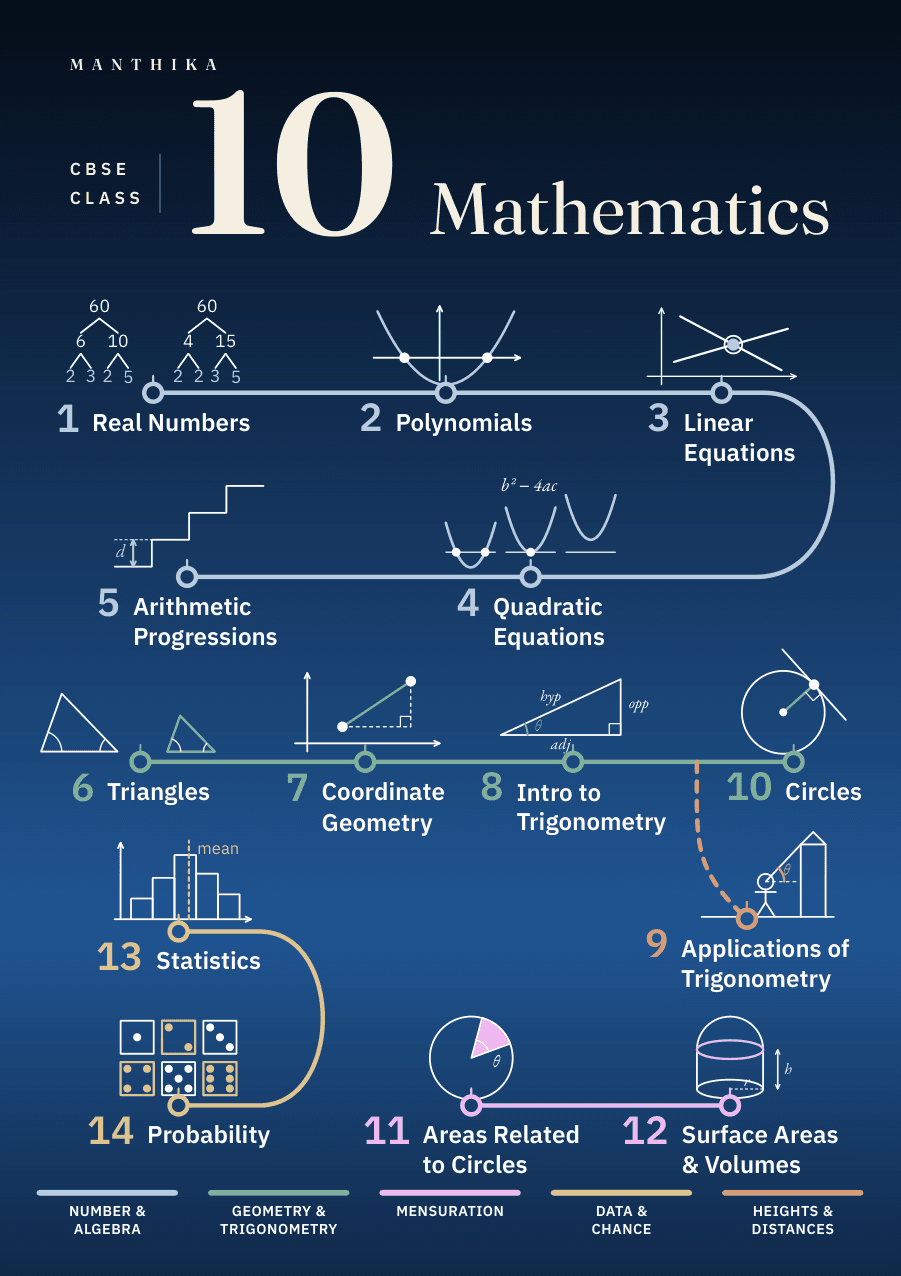
Mathematics · Class 10
Manthika Mathematics · Class 10 · CBSE
All 14 chapters on the siteThe promise
A Class 9 or 10 student with no tutor can learn every syllabus topic from this book alone, practise it to board-paper standard, and check every answer on the page.
That means nothing is left for a teacher to fill in. Each chapter starts where you are, builds the idea step by step, and shows worked examples before it sets you a problem. Where a chapter needs something from last year, it teaches that too instead of assuming it. The first problem of every set is solved in full on the page, with the reason beside each step; the rest are answered under the set, with every full solution online, free.
Mathematics, Class 10, on the 2026–27 CBSE syllabus — the board year.
Topic list & syllabus map
Real Numbers
- Fundamental Theorem of Arithmetic (statement, after reviewing earlier work, motivated through examples). Proofs of irrationality of √2
- √3
- √5. Competency: "prove algebraically the irrationality of numbers like √2, √3, √5, 3 + 2√5"
Polynomials
- zeros of a polynomial
- relationship between zeros and coefficients of quadratic polynomials
- find zeros graphically and algebraically
Linear Equations
- graphical method
- consistency/inconsistency
- algebraic conditions for number of solutions
- solution by substitution and by elimination
- simple situational problems
Quadratic Equations
- standard form ax² + bx + c = 0
- solutions (only real roots) by factorisation and by the quadratic formula
- discriminant and nature of roots
- situational problems from day-to-day activities
Arithmetic Progressions
- motivation
- derivation of the nth term and the sum of the first n terms
- daily-life applications
Coordinate Geometry
- review of concepts
- distance formula
- section formula (internal division only)
Triangles
- definitions
- examples
- counter-examples of similar triangles. (Prove) Basic Proportionality Theorem. State without proof: its converse
- AA
- SSS
- SAS similarity criteria. Competency: differentiate congruent from similar figures
Circles
- tangent at the point of contact. (Prove) the tangent is perpendicular to the radius through the point of contact. (Prove) the lengths of tangents from an external point are equal
Intro to Trigonometry
- ratios of an acute angle of a right triangle
- proof of their existence (well-defined)
- motivate the ratios defined at 0° and 90°
- values at 30°
- 45°
- 60°
- relationships between the ratios
- proof and applications of sin²A + cos²A = 1
- only simple identities
- (topics combined from freeze items 9 (Introduction to Trigonometry), 10 (Trigonometric Identities) -- this book folds them into one chapter)
Applications of Trigonometry
- angle of elevation
- angle of depression
- simple problems
- at most two right triangles
- angles only 30°
- 45°
- 60°
Areas Related to Circles
- area of sectors and segments
- problems on areas and perimeter or circumference of these figures
- segment problems restricted to central angles 60°
- 90°
- 120°
Surface Areas & Volumes
- surface areas and volumes of combinations of any two of cubes
- cuboids
- spheres
- hemispheres
- right circular cylinders and cones
Statistics
- mean
- median and mode of grouped data (bimodal situations avoided)
- mean by direct
- assumed-mean and step-deviation methods
- median and mode by the algebraic method
Probability
- classical definition
- simple problems on the probability of an event
What it is — and isn't
It follows the CBSE Mathematics syllabus for 2026–27 chapter by chapter, in NCERT's order. Each chapter teaches its idea from the beginning, shows worked examples before it sets a problem, and names the mistakes students actually make. Where a chapter needs something from the previous class, the book teaches that too rather than assume the reader has it. The first problem of every set is solved in full on the page, with the reason beside each step; the rest are answered under the set, with every full solution online, free. The back matter carries the solutions, a formula sheet, a mistakes index and a glossary.
What it is not: an NCERT solutions book — it solves its own problems only; a sample-paper or previous-year-paper bank; a coaching module or test series; a CBSE or NCERT publication; the school — no lab work, projects or internal-assessment help. It is one book for both Class 10 maths papers, Basic and Standard, with no Basic-only shortcut.
Read a chapter, free
Free to read: these chapters open in any browser, with no account.